
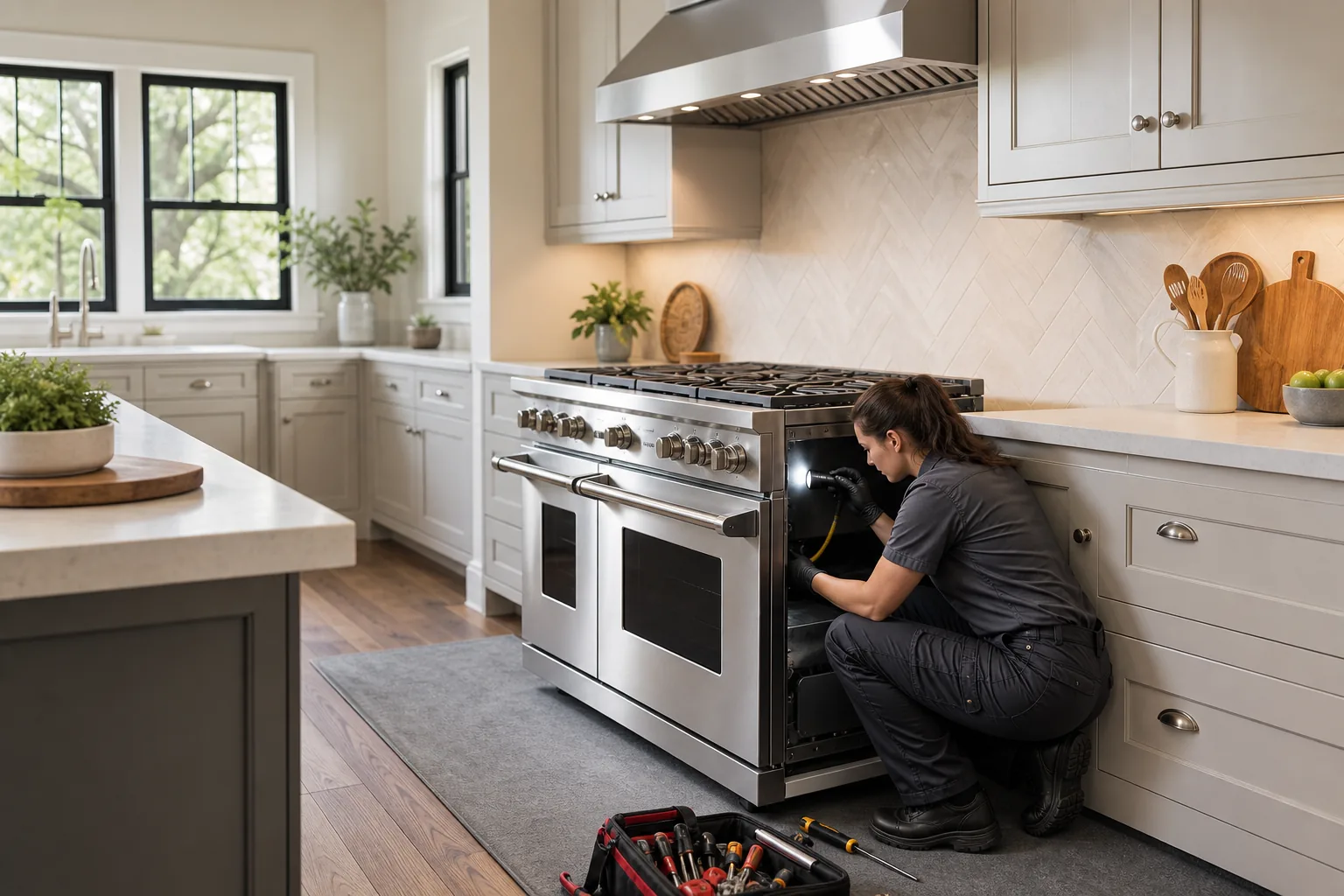
Viking's premium cooking platforms include wide 7 Series and Tuscany configurations with substantial oven capacity and varied surface layouts. More burners, griddles, multiple cavities, and advanced controls create more diagnostic branches; they do not justify replacing several parts at once. The failed subsystem still needs to be isolated by position, mode, and timing.
Identify the exact equipment first
- 7 Series gas and dual-fuel ranges
- Tuscany range configurations
- Wide ranges with multiple oven cavities
- Specialized griddle and multi-burner cooking surfaces
- Photograph the complete Viking model and serial tag before scheduling service
Protect people, property, and stored product first. Stop for gas odor, smoke, damaged wiring, active leaks near electrical parts, or repeated breaker trips. Leave internal gas, refrigerant, and live-voltage testing to a qualified technician.
Systems that shape the diagnosis
Multi-cavity oven systems
A wide range may use separate heating, sensing, fans, and controls for each cavity. Comparing left and right oven behavior helps identify local versus shared faults.
High-output surface cooking
Burner ports, igniters, valves, regulation, and top modules must be matched to the exact position. Weak flame on one burner differs from low output across the appliance.
Griddle control
Integrated griddles add dedicated thermostats, sensors, ignition or heating components, and grease-management context. Surface temperature should be measured across zones rather than judged from warm-up time alone.
Heat management
Large ranges generate significant cabinet heat. Cooling fans, ventilation, clearances, and control temperature can explain faults that appear only during long cooking cycles.
How the premium range series format changes diagnosis
Map every complaint to its exact position: burner, griddle zone, left or right oven, and cooking mode. Record cold-start behavior and what changes after sustained heat. This structured comparison prevents a shared control from being blamed for a single local fault, or vice versa.
Repair planning, access, and installation
Premium ranges can be exceptionally heavy. Safe access may require multiple technicians, proper moving equipment, floor protection, gas and power isolation, and confirmation of anti-tip and ventilation conditions. Do not promise rear-access work without understanding the installation.
Why the full model number matters
A wide stainless Viking range is not automatically a 7 Series or Tuscany model. Knob layout and door count help describe it, but only the tag identifies the platform, fuel, width, and revision needed for documentation and parts.
Frequently asked questions
Is a Tuscany range the same as a 7 Series range?
No. They are distinct product platforms with different configurations and documentation. Confirm the model before service planning.
Why does one oven work while the other stays cold?
Wide ranges can use separate cavity components. The failed oven's heat source, sensor, relay, fan, and wiring need comparison with the working cavity.
Will a premium range always need to be pulled out?
Not always. Many operating and front-access checks come first. Removal depends on the component, model, and installation.
Where should I find the model number before Viking service?
Use the rating-plate location shown in the owner documentation for the exact premium range series configuration. Photograph the complete plate rather than typing a partial number, because suffixes and production revisions can change parts and procedures.
Ghost Appliance Repair is an independent service company and is not affiliated with or endorsed by Viking or its manufacturer. Brand and family names identify the equipment discussed. Availability of service depends on the exact model, condition, parts support, and location.