
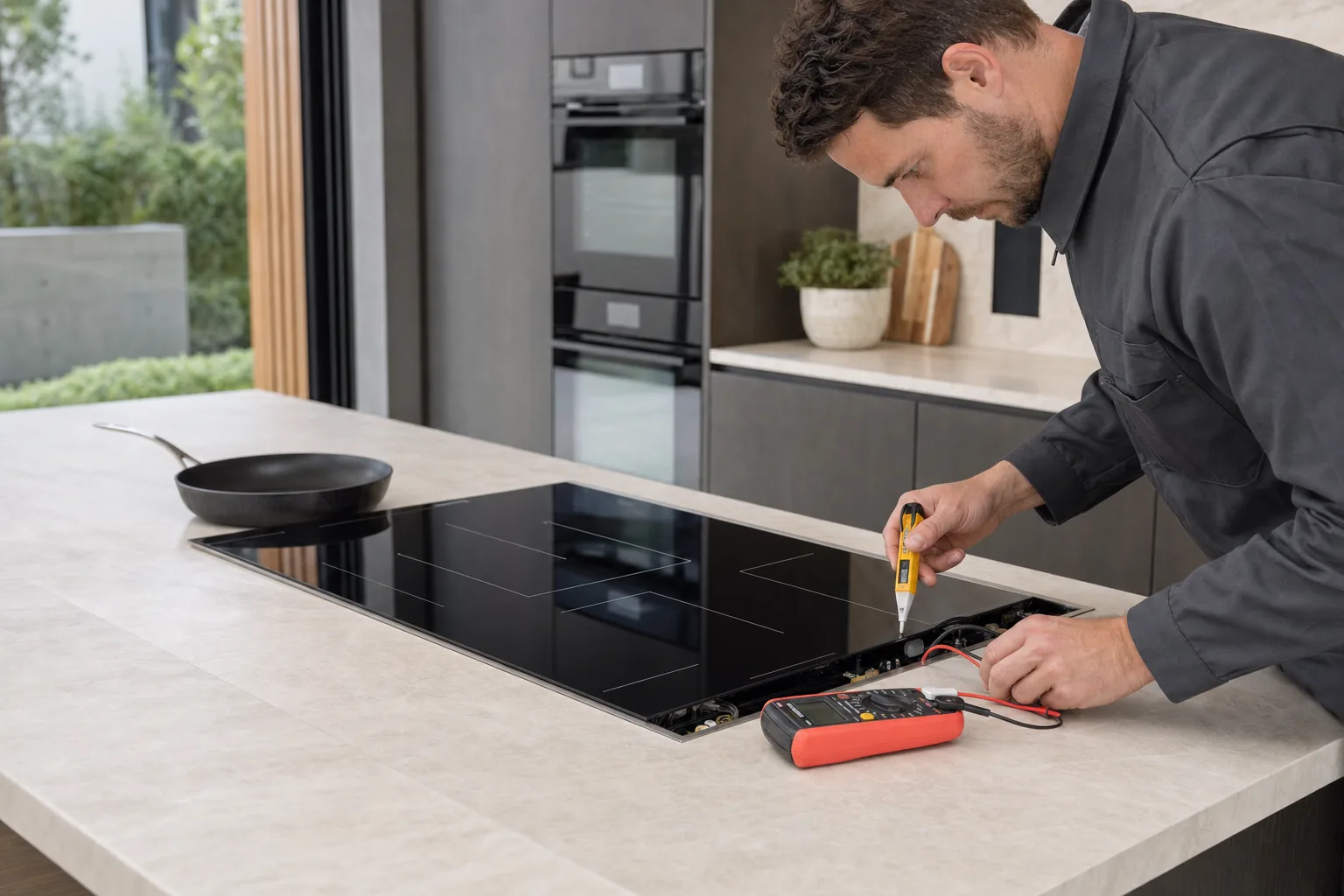
Induction cooktops heat compatible cookware through electronically controlled magnetic fields. A zone that does not heat can involve cookware, pan detection, a temperature sensor, cooling airflow, wiring, a power module, or the user interface. Because multiple zones may share electronics, the pattern across the glass is more informative than one error message alone.
Identify the exact equipment first
- Framed and frameless induction cooktops
- Multiple widths and zone layouts
- Current touch-control platforms
- Legacy induction models and modular cooktop installations
- Photograph the complete Wolf model and serial tag before scheduling service
Protect people, property, and stored product first. Stop for gas odor, smoke, damaged wiring, active leaks near electrical parts, or repeated breaker trips. Leave internal gas, refrigerant, and live-voltage testing to a qualified technician.
Systems that shape the diagnosis
Cookware recognition
Pan material, base diameter, flatness, and placement affect detection. Testing with known compatible cookware distinguishes a usage variable from an appliance fault.
Shared power modules
Two or more zones may depend on one inverter or power module. A paired-zone failure pattern can therefore identify the affected electronics more clearly than a single cold position.
Cooling fans and temperature limits
Power electronics produce heat and rely on airflow. A loaded fan, restricted cabinet opening, or temperature sensor can reduce output or stop operation after warm-up.
Supply and communication
High-current supply, terminal connections, filters, harnesses, and the touch interface all participate. A lit display does not prove that the power stage receives correct voltage.
How the induction cooktop format changes diagnosis
Confirm compatible cookware and note whether one, paired, or all zones fail. Record the full error, fan behavior, time to shutdown, and whether the control responds normally. Internal testing involves hazardous voltage and stored electrical energy, so module and supply diagnosis belongs to qualified service.
Repair planning, access, and installation
Cooktop access depends on the countertop cutout, seal, drawers or ovens below, and the ability to support the glass safely. Do not pry against stone or lift the cooktop from one corner. The service plan should identify the model, installation below, and whether cabinet ventilation is obstructed.
Why the full model number matters
Similar black-glass surfaces can hide different generation controls and module layouts. The model tag and zone diagram determine which positions share electronics and which documentation applies. Photograph any error display as well as the rating plate.
Frequently asked questions
Why do two Wolf induction zones fail together?
Paired zones may share a power module or supply path. That pattern is useful evidence, though wiring, controls, and cooling still need testing.
Can the cooktop work with one pan but not another?
Yes. Magnetic compatibility, base size, flatness, and placement affect detection. Use known induction-ready cookware before assuming a component failure.
Is it safe to open an induction cooktop after turning off the breaker?
No homeowner internal access is recommended. Power electronics can retain hazardous energy, and glass removal requires installation-specific handling.
Where should I find the model number before Wolf service?
Use the rating-plate location shown in the owner documentation for the exact induction cooktop configuration. Photograph the complete plate rather than typing a partial number, because suffixes and production revisions can change parts and procedures.
Ghost Appliance Repair is an independent service company and is not affiliated with or endorsed by Wolf or its manufacturer. Brand and family names identify the equipment discussed. Availability of service depends on the exact model, condition, parts support, and location.