
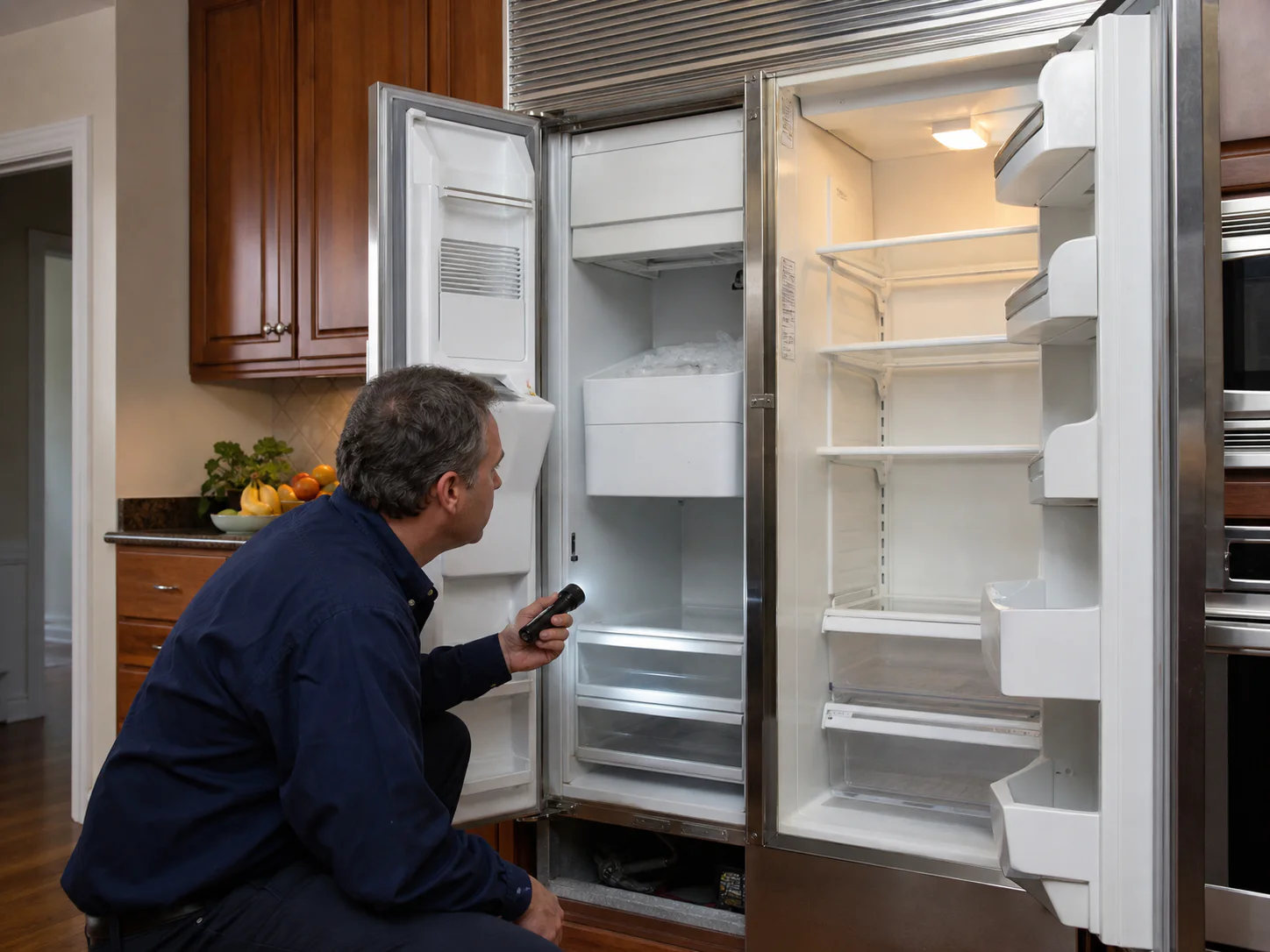
The 680 and 685 are legacy wide side-by-side platforms with an exterior ice and water delivery branch. A useful diagnosis separates refrigerator cooling, freezer cooling, ice production, bucket and auger delivery, dispenser controls, and household water supply. A no-ice complaint is not automatically a dispenser failure, and a dispenser that will not deliver existing cubes is not automatically an ice-maker failure.
Identify the exact equipment first
- Confirm 680 versus 685 and whether the complaint involves production or delivery
- Measure refrigerator and freezer temperatures separately
- Inspect the ice bucket, door chute, and accessible water shutoff
- Photograph the complete Sub-Zero 680 and 685 model and serial tag
- Record actual temperatures, error messages, noises, and the operating stage when the symptom appears
Protect people, property, and stored product first. Stop for gas odor, smoke, damaged wiring, active leaks near electrical parts, or repeated breaker trips. Leave internal gas, refrigerant, and live-voltage testing to a qualified technician.
Systems that shape the diagnosis
Compartment-specific cooling
Refrigerator and freezer temperatures, fan operation, frost, sensing, and door contact are compared before a shared refrigeration fault is assumed.
Ice production sequence
Freezer temperature, water fill, fill-tube condition, mold harvest, and bin position determine whether cubes are being made.
Dispenser delivery path
Bucket coupling, auger movement, chute switches, door interlocks, controls, and dispenser wiring are separate from the ice-making cycle.
Water valve and supply
Household pressure, tubing, valve command, valve shutoff, and dispenser flow can create no-water, slow-fill, or leaking symptoms.
Legacy controls and door hardware
Production age makes complete serial identification important for switches, boards, harnesses, gaskets, hinges, and dispenser parts.
Platform and production context
The 680 and 685 belong to the legacy built-in side-by-side generation that remains common in custom kitchens. Their dispenser architecture distinguishes them from non-dispenser 632 and 642 platforms.
Two temperature compartments share the cabinet and upper machine area while the freezer door carries the delivery branch. Ice creation, ice delivery, and water delivery must be tested as related but distinct systems.
Separate the symptom before selecting parts
If cubes are absent, start with measured freezer temperature and water fill. If cubes exist but do not dispense, follow the bucket, auger, chute, switches, and controls. If both compartments warm, shared condenser airflow, controls, power, and refrigeration capacity become more important.
Access, identification, and service planning
The wide cabinet and loaded freezer door require floor, panel, water-line, anti-tip, and cabinetry protection. Most diagnosis should be completed in place before any removal decision.
Record the complete 680 or 685 suffix and serial number. Similar exterior trim does not establish the dispenser, control, or production revision needed for parts selection.
Frequently asked questions
Why does the 685 dispenser run while no ice comes out?
The motor can operate while the bucket is empty, jammed, miscoupled, or blocked at the chute. Confirm whether ice was produced before diagnosing delivery.
Can a warm freezer stop ice before food thaws?
Yes. Ice production can decline at a temperature where food still feels frozen, so a measured freezer temperature is essential.
Is a 680 dispenser problem the same as a 632 ice problem?
No. The 680 and 685 add an exterior delivery path that the non-dispenser 632 does not use.
Why is the full Sub-Zero 680 and 685 serial information required?
Production revisions can change controls, wiring, hinges, water components, and compatible replacement parts while the visible model family remains similar. The full tag keeps service planning tied to the correct technical documentation.
Ghost Appliance Repair is an independent service company and is not affiliated with or endorsed by Sub-Zero or its manufacturer. Brand and model names identify the equipment discussed. Service and parts availability depend on the complete model, serial generation, condition, and location.