
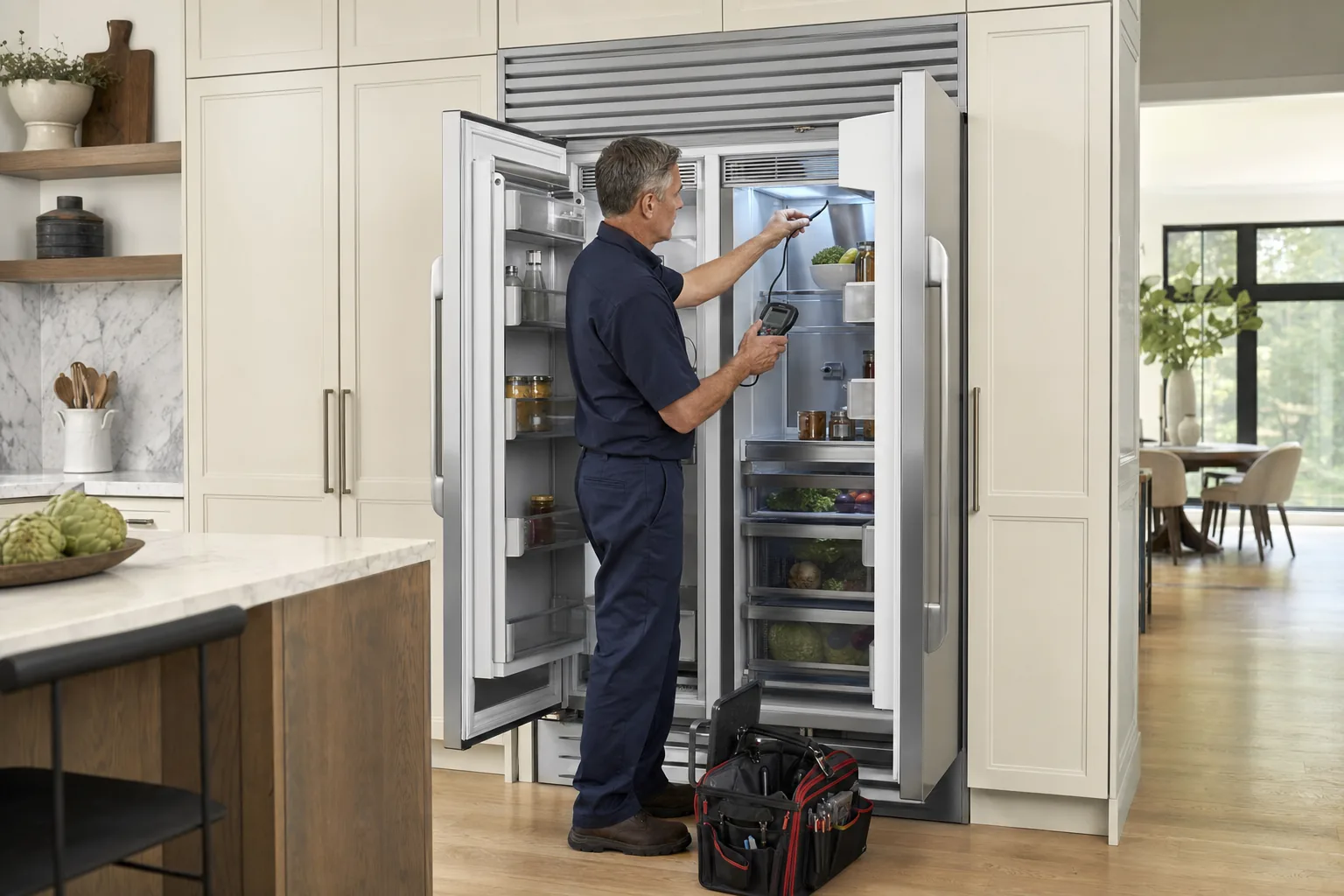
Sub-Zero built-in refrigeration spans multiple cabinet layouts and generations. An over-and-under unit, a side-by-side cabinet, and a legacy built-in can share a cooling complaint while using different evaporator, fan, control, drain, and access arrangements. The useful starting point is the exact model and the temperature pattern in each compartment, not the age or appearance alone.
Identify the exact equipment first
- Over-and-under refrigerator and freezer configurations
- Side-by-side fresh-food and freezer cabinets
- Classic Series and earlier built-in generations
- Stainless and panel-ready installations with top mechanical access
- Photograph the complete Sub-Zero model and serial tag before scheduling service
Protect people, property, and stored product first. Stop for gas odor, smoke, damaged wiring, active leaks near electrical parts, or repeated breaker trips. Leave internal gas, refrigerant, and live-voltage testing to a qualified technician.
Systems that shape the diagnosis
Compartment-specific airflow
A warm fresh-food section with a stable freezer can point toward a refrigerator-side fan, evaporator, sensor, air path, or defrost condition. Both sections warming together shifts attention toward condenser airflow, shared controls, power, or refrigeration capacity.
Top-mounted heat rejection
Many full-height built-in configurations use an upper machine area. Dust loading, fan trouble, restricted grille airflow, or recirculated warm air can increase run time and cabinet temperature without proving a compressor failure.
Door, hinge, and panel load
Heavy doors and decorative panels influence alignment and gasket contact. Humid air entering through one corner can create condensation, localized frost, and extended run time before a clear temperature alarm appears.
Generation-specific controls
Legacy dial controls, electronic boards, thermistors, and service messages require different test methods. A displayed setting or vacuum-condenser reminder is evidence to record, not a complete diagnosis.
How the built-in refrigerator format changes diagnosis
The cabinet layout determines which temperature readings must be compared and which systems can fail independently. Diagnosis should document actual temperatures, fan behavior, frost pattern, condenser condition, door sealing, and control history before sealed-system work is considered. That sequence is especially important on dual-refrigeration designs, where one compartment can remain normal while the other loses capacity.
Repair planning, access, and installation
Built-in replacement can affect custom panels, surrounding cabinetry, flooring, and ventilation clearances, so the repair decision is broader than appliance age. Access to the upper machine area must be protected, and any move-out plan should account for anti-tip hardware and finished surfaces. Fans, sensors, drains, gaskets, controls, and sealed-system repairs belong to very different cost and time categories.
Why the full model number matters
Classic and earlier built-in products can look similar from across the kitchen while using different service parts and diagnostic references. The complete model and serial information helps identify cabinet configuration, generation, electrical documentation, and parts support. It also prevents a side-by-side symptom from being treated like an over-and-under airflow problem.
Frequently asked questions
Is every full-height Sub-Zero a built-in refrigerator?
No. Classic built-in cabinets, Designer integrated columns, and PRO refrigeration differ in architecture and installation. The model tag is the reliable way to place the appliance in the correct family.
Why is the refrigerator warm while the freezer still works?
The fresh-food side may have its own evaporator, fan, sensor, defrost circuit, or air path. A stable freezer does not prove that all refrigeration components are operating normally.
Does a vacuum-condenser message mean the compressor is bad?
No. The message directs attention toward maintenance and heat rejection. Temperature, fan operation, condenser condition, door sealing, and cooling pattern still need to be evaluated.
Where should I find the model number before Sub-Zero service?
Use the rating-plate location shown in the owner documentation for the exact built-in refrigerator configuration. Photograph the complete plate rather than typing a partial number, because suffixes and production revisions can change parts and procedures.
Ghost Appliance Repair is an independent service company and is not affiliated with or endorsed by Sub-Zero or its manufacturer. Brand and family names identify the equipment discussed. Availability of service depends on the exact model, condition, parts support, and location.