
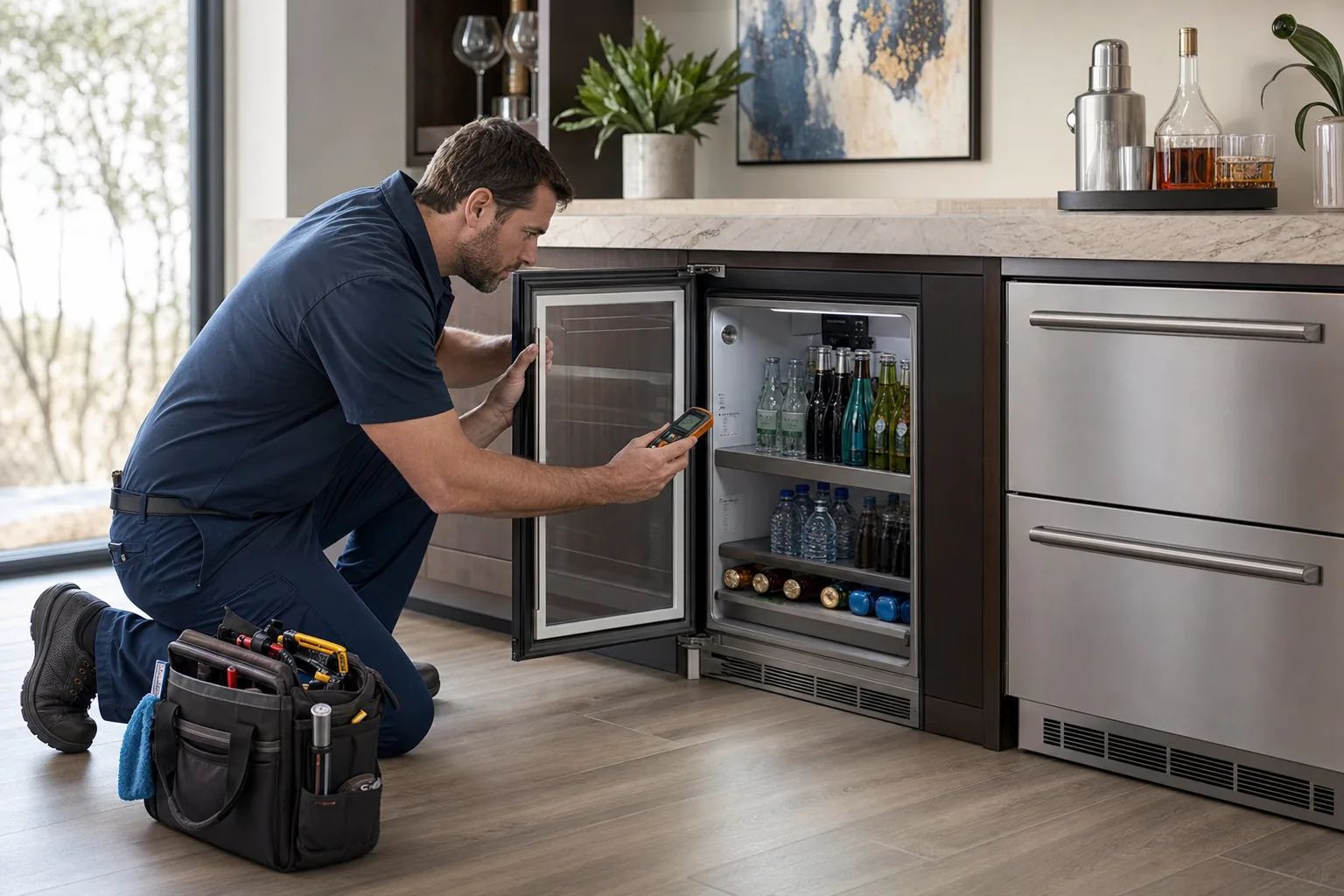
Undercounter refrigeration is not one appliance type. The family can include beverage centers, solid-door refrigerators, refrigerated drawers, wine storage, and ice makers in indoor or outdoor installations. Water systems, cabinet temperature, drawer alignment, glass condensation, and ventilation therefore need different diagnostic paths even when every unit occupies a similar 24-inch opening.
Identify the exact equipment first
- Solid-door undercounter refrigerators
- Refrigerated drawer units
- Beverage centers and undercounter wine storage
- Dedicated undercounter ice makers and approved outdoor installations
- Photograph the complete Sub-Zero model and serial tag before scheduling service
Protect people, property, and stored product first. Stop for gas odor, smoke, damaged wiring, active leaks near electrical parts, or repeated breaker trips. Leave internal gas, refrigerant, and live-voltage testing to a qualified technician.
Systems that shape the diagnosis
Front ventilation
Undercounter units reject heat through a compact grille. Dust, blocked toe-kick space, weak fan airflow, or a tight enclosure can raise operating temperature and run time.
Drawer and door sealing
A drawer that does not close evenly or a glass door with poor gasket contact admits humid air. Condensation location and closing resistance often reveal the mechanical pattern.
Water and ice-making circuits
Ice makers add fill valves, pumps, drains, water quality, and harvest controls. No ice, thin ice, overflowing, and leaking are separate symptoms that should not be reduced to a refrigeration diagnosis.
Indoor versus outdoor exposure
Approved outdoor products face ambient heat, humidity, debris, and seasonal conditions. Installation rating and actual environment matter when evaluating condensation and cooling performance.
How the undercounter refrigeration format changes diagnosis
Identify the product category before testing. A wine unit needs zone-by-zone temperature evidence, a drawer unit needs alignment and sealing checks, and an ice maker needs water and drain observations in addition to refrigeration measurements. For every format, verify front airflow and the cabinet opening before condemning an internal component.
Repair planning, access, and installation
Compact equipment can still be difficult to remove when flooring, leveling legs, adjacent panels, or countertop overhangs restrict movement. Water-equipped units also require connection and drain planning. Protect the cabinet face and floor, document installation clearances, and determine whether the fault can be tested through front access first.
Why the full model number matters
A beverage center and wine unit may look almost identical behind tinted glass, while a drawer product can share external dimensions with a solid-door refrigerator. The full model number identifies temperature range, water components, outdoor approval, and correct service parts.
Frequently asked questions
Why is my undercounter refrigerator warm but still running?
Restricted front airflow, a weak fan, door leakage, sensor error, frost, or reduced refrigeration capacity can all produce long run time with poor temperature.
Is condensation on a glass door always a failure?
No. Room humidity and door openings matter, but persistent or localized condensation can indicate gasket contact, alignment, heater, or control issues.
Can every undercounter unit be installed outdoors?
No. Outdoor suitability is model-specific. Confirm the exact rating before using ambient conditions as part of the diagnosis or installation plan.
Where should I find the model number before Sub-Zero service?
Use the rating-plate location shown in the owner documentation for the exact undercounter refrigeration configuration. Photograph the complete plate rather than typing a partial number, because suffixes and production revisions can change parts and procedures.
Ghost Appliance Repair is an independent service company and is not affiliated with or endorsed by Sub-Zero or its manufacturer. Brand and family names identify the equipment discussed. Availability of service depends on the exact model, condition, parts support, and location.