
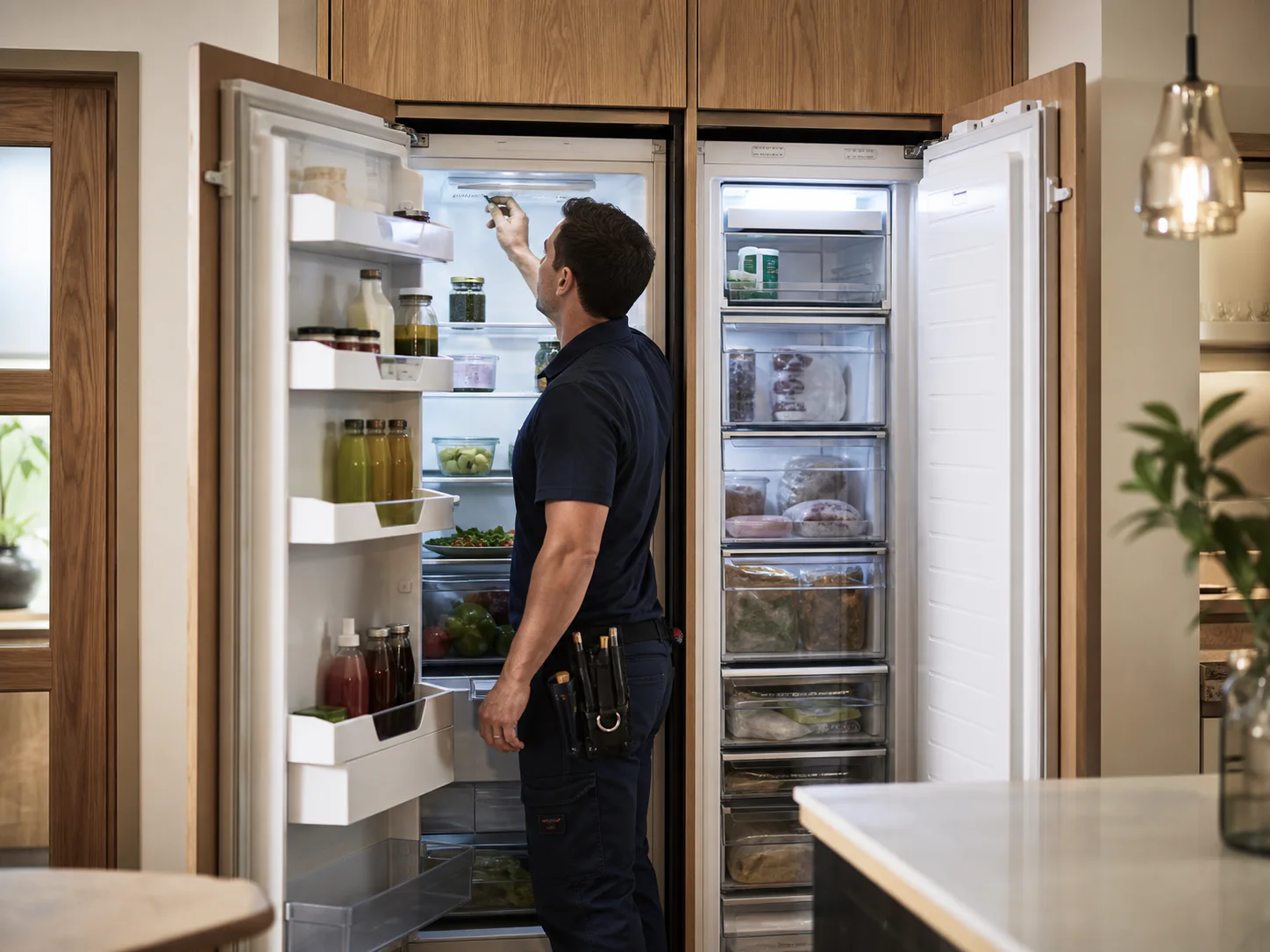
The tall 700 Series includes all-refrigerator 700TR, all-freezer 700TF or 700TFI, and combination 700TC or 700TCI configurations. Their flush custom-panel appearance can hide major system differences. The first service decision is whether the cabinet is refrigerator-only, freezer-only, or combined, and whether the symptom follows the full height or one compartment.
Identify the exact equipment first
- Confirm TR, TF/TFI, or TC/TCI configuration
- Map temperature at upper, center, and lower storage levels
- Inspect the full-height panel and lower drawers for even gasket contact
- Photograph the complete Sub-Zero 700TR, 700TF, and 700TC columns model and serial tag
- Record actual temperatures, error messages, noises, and the operating stage when the symptom appears
Protect people, property, and stored product first. Stop for gas odor, smoke, damaged wiring, active leaks near electrical parts, or repeated breaker trips. Leave internal gas, refrigerant, and live-voltage testing to a qualified technician.
Systems that shape the diagnosis
Tall-cabinet airflow
Fan output, frost, returns, and loading can create a vertical temperature difference that one shelf reading misses.
Refrigerator versus freezer architecture
Defrost, ice, and low-temperature symptoms belong only to freezer-equipped versions; the all-refrigerator follows a different circuit.
Full-height panel sealing
Panel weight, hinge geometry, gasket compression, and surrounding cabinetry can create localized humidity entry.
Showroom and legacy control behavior
Showroom-mode procedures and control revisions vary by model and serial break, making the failed state and tag important.
Integrated heat rejection
Condenser airflow and installation ventilation must be evaluated before long run time is treated as compressor failure.
Platform and production context
The core 700TR, 700TF, and 700TC platform was produced across the legacy 700 Series period, with different ending years and serial revisions. It predates current Designer columns.
A narrow tall cabinet may contain one temperature system or a refrigerator-freezer combination. Controls, evaporator airflow, defrost, drains, ice equipment, doors, drawers, and top/bottom air paths depend on the suffix.
Separate the symptom before selecting parts
Uniform warming across a single-zone column suggests shared airflow, controls, heat rejection, or cooling capacity. A warm zone in a combination cabinet requires compartment comparison. Ice and alarm symptoms must be tied to actual freezer temperature.
Access, identification, and service planning
Preserve custom panel alignment and record cabinet reveals. Confirm ventilation and electrical access before moving a tall integrated unit from millwork.
The final letters distinguish refrigerator, freezer, combination, and ice-maker equipment. A generic 700 model description is not enough for safe parts planning.
Frequently asked questions
What is the difference between 700TR and 700TF?
The 700TR is an all-refrigerator configuration; the 700TF family is freezer equipment.
Why does the display show room temperature?
Showroom mode is one possibility on this family, but controls, sensing, and cooling operation still require model- and serial-specific evaluation.
Can a 700TC have one warm section?
Yes. A combination model can develop compartment-specific airflow, sensing, sealing, or cooling symptoms.
Why is the full Sub-Zero 700TR, 700TF, and 700TC columns serial information required?
Production revisions can change controls, wiring, hinges, water components, and compatible replacement parts while the visible model family remains similar. The full tag keeps service planning tied to the correct technical documentation.
Ghost Appliance Repair is an independent service company and is not affiliated with or endorsed by Sub-Zero or its manufacturer. Brand and model names identify the equipment discussed. Service and parts availability depend on the complete model, serial generation, condition, and location.