
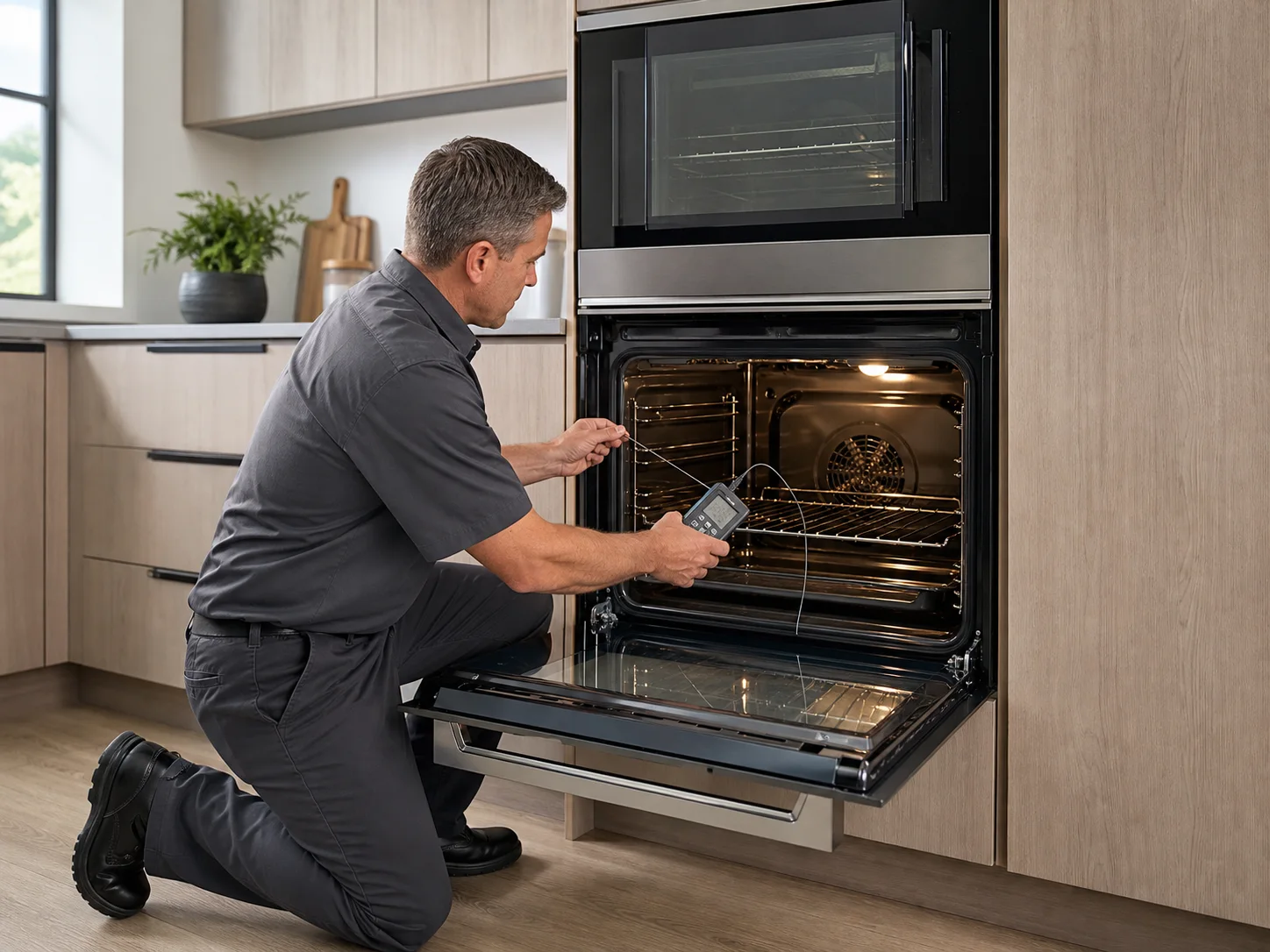
Thermador MED and MEM wall ovens covers legacy Masterpiece and related single or double electric wall-oven platforms. MED and MEM generations with model-specific displays, relays, convection equipment, and trim. Single and double cavities can share installation power while retaining separate elements, sensors, fans, and door systems. This guide organizes the evidence needed before a component or parts path is chosen.
Identify the exact equipment first
- Photograph the complete Thermador MED and MEM wall ovens model and serial tag
- Identify the exact MED / MEM Ovens cavity, cooking mode, and stage of failure
- Compare bake, broil, convection, preheat, temperature-probe, door, and cooling-fan behavior
- Record codes and measured cavity temperature without clearing the original operating pattern
- Preserve the original error, frost, leak, or operating pattern whenever it is safe to do so
Protect people, property, and stored product first. Stop for gas odor, smoke, damaged wiring, active leaks near electrical parts, or repeated breaker trips. Leave internal gas, refrigerant, and live-voltage testing to a qualified technician.
Systems that shape the diagnosis
Mode-specific heating circuits
Elements, relays, wiring, high-limit protection, and incoming power can remove one Thermador MED and MEM wall ovens mode while the display and another mode continue to work.
Convection and cavity airflow
Fan motors, blades, relays, and air paths affect temperature uniformity, preheat, and mode-specific noise in MED / MEM Ovens.
Temperature feedback
Sensor response, actual heat output, door sealing, rack position, and stabilized cycling are evaluated before calibration.
Door, hinge, latch, and lock
Closure geometry affects heat retention, while latch and self-clean conditions can prevent operation or create a separate error on Thermador MED and MEM wall ovens.
Controls and cabinet cooling
Interface response, relay commands, communication, cooling fans, and installation ventilation can cause shutdown after the oven warms.
Platform, configuration, and production context
Thermador MED and MEM wall ovens is organized here as legacy Masterpiece and related single or double electric wall-oven platforms. MED and MEM generations with model-specific displays, relays, convection equipment, and trim. Finish, panel, hinge, and decorative suffixes remain on this page unless they change the service architecture.
Single and double cavities can share installation power while retaining separate elements, sensors, fans, and door systems.
Turn the complaint into a diagnostic pattern
Separate no heat, one missing mode, slow preheat, inaccurate temperature, fan noise, door trouble, and hot shutdown on Thermador MED and MEM wall ovens. Single and double cavities can share installation power while retaining separate elements, sensors, fans, and door systems.
Record what still works, what changed first, whether the symptom is constant or intermittent, and what happens after the MED / MEM Ovens appliance warms under load. That sequence is more useful than replacing the most familiar part associated with the symptom.
Access, parts, and repair planning
Heavy chassis removal should follow front-access electrical and temperature testing and requires cabinet protection and proper support.
Use the complete Thermador MED and MEM wall ovens tag and serial generation for wiring, controls, hinges, fans, sensors, water components, and replacement-part research. A visually similar appliance or matching cabinet width does not establish compatibility.
Frequently asked questions
What should be recorded before Thermador MED and MEM wall ovens service?
Send the full model and serial tag, the exact failed zone or mode, measured temperatures where relevant, error messages, recent noises, and clear photos of frost, water, door alignment, or installation conditions.
Can one part of MED / MEM Ovens work while another part fails?
Yes. Single and double cavities can share installation power while retaining separate elements, sensors, fans, and door systems. Diagnosis should follow the exact zone, mode, cavity, or cycle stage rather than assuming the entire appliance has one shared fault.
Should Thermador MED and MEM wall ovens be removed from the installation first?
Usually not. Front-access and in-place operating evidence should define the likely repair category before movement. Heavy chassis removal should follow front-access electrical and temperature testing and requires cabinet protection and proper support.
Why does the complete Thermador MED and MEM wall ovens serial information matter?
Production revisions can change controls, wiring, hinges, water components, service access, and compatible replacement parts while the appliance keeps a similar exterior appearance.
Ghost Appliance Repair is an independent service company and is not affiliated with or endorsed by Thermador or its manufacturer. Brand and model names identify the equipment discussed. Service and parts availability depend on the complete model, serial generation, condition, and location.