
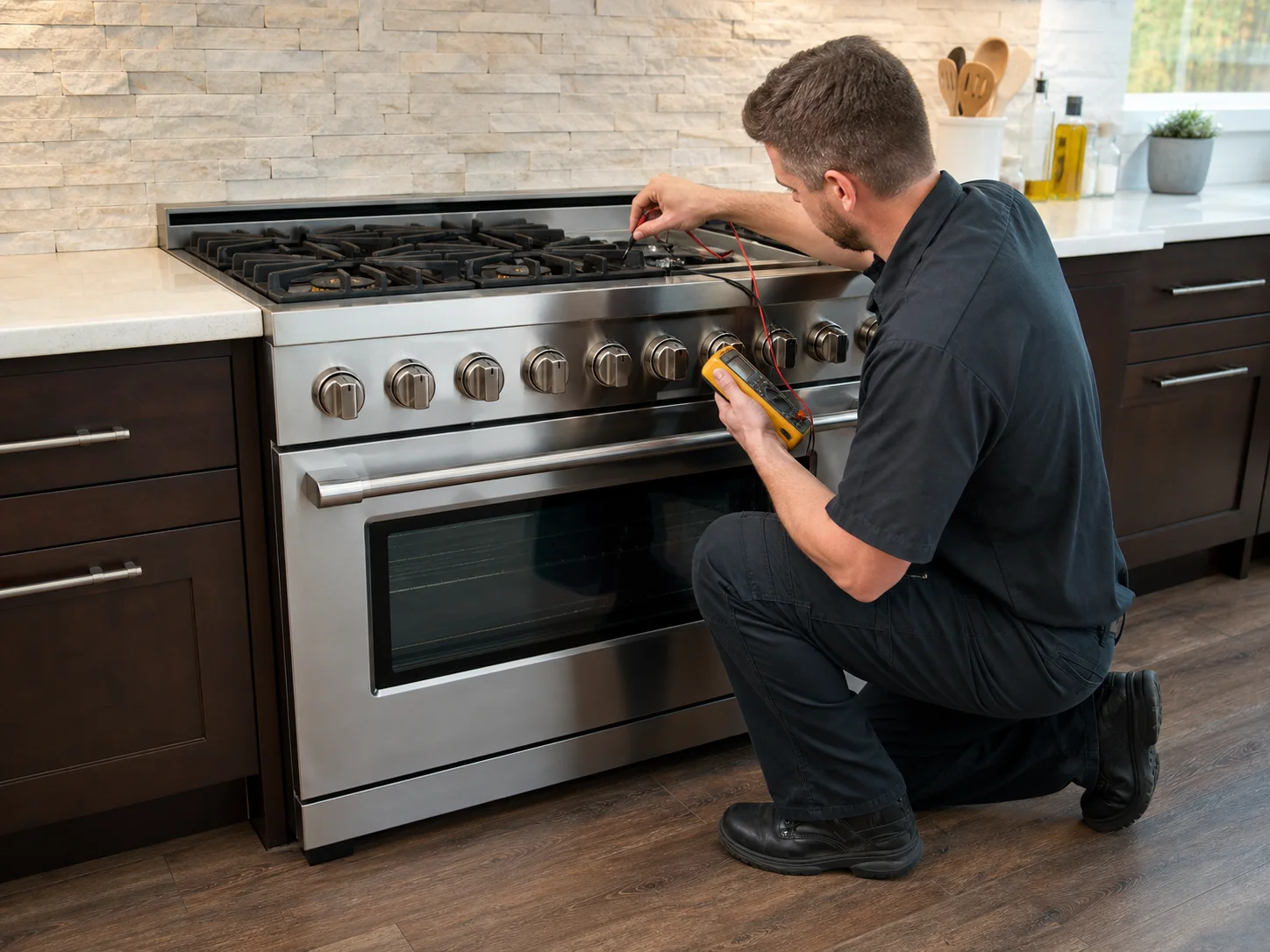
Wolf DF36 identifies a 36-inch dual-fuel platform: gas surface cooking above an electric convection oven. Legacy DF366, DF364G, and DF364C configurations and current DF3650-era successors can share width and service intent while using different controls and surface modules. The complaint must be tied to a burner, griddle or charbroiler, oven mode, fan, display, or power stage.
Identify the exact equipment first
- Photograph the complete Wolf DF36 and DF3650 model and serial tag
- Record the full DF36 model, serial, fuel, and surface layout
- Identify the exact burner, module, oven mode, and operating stage affected
- Confirm whether the symptom is gas-surface, electric-oven, control, or cooling related
- Record actual temperatures, operating mode, error messages, and when the symptom began
Protect people, property, and stored product first. Stop for gas odor, smoke, damaged wiring, active leaks near electrical parts, or repeated breaker trips. Leave internal gas, refrigerant, and live-voltage testing to a qualified technician.
Systems that shape the diagnosis
Surface spark and reignition
Burner caps, ports, electrodes, switches, grounding, wiring, spark modules, and flame recognition affect lighting and repeated clicking.
Electric oven heating circuits
Bake, broil, convection elements, relays, sensors, wiring, and the 240/208-volt supply determine heat even when gas burners work normally.
Griddle or charbroiler configuration
A DF364G and DF364C add different dedicated components. Width alone does not identify which module or service procedure applies.
Convection and cabinet cooling
Cooking fans distribute heat while cooling airflow protects controls. Noise and shutdown timing help identify which fan system is involved.
Legacy versus current controls
Legacy knob and display architecture differs from newer touchscreen and connected controls. Codes and reset steps must be tied to the exact generation.
Platform and generation
Official Wolf timelines list legacy DF36 variants beginning in 2002 and ending in 2020, followed by current 36-inch DF3650-generation products. They remain one search cluster but require generation-specific documentation.
Dual fuel means the surface and oven use different energy and control paths. A working gas burner does not prove the electric oven has correct power, and a working oven does not prove every spark switch or module is healthy.
How symptoms should be separated
Name the position and mode: one burner not igniting, all burners clicking, griddle not heating, bake missing, broil working, slow preheat, temperature drift, fan noise, or dark controls. Each pattern narrows a different branch.
Access, parts, and repair planning
The range is heavy and connected to gas and high-current electricity. Front and top tests should be completed before movement. Rear access requires gas shutoff, electrical isolation, floor protection, anti-tip awareness, and sufficient clearance.
DF36 is a family shorthand. Capture identifiers such as DF366, DF364G, DF364C, or the complete current model because surface modules, controls, electrical loads, and parts differ.
Frequently asked questions
Why do Wolf DF36 burners work but the oven does not heat?
The gas surface and electric oven use separate systems. Oven supply, elements, relays, sensors, wiring, and controls still require testing.
Are all DF36 tops configured the same way?
No. Models can use six burners or add griddle or charbroiler equipment. The complete model identifies the surface layout.
Can continuous clicking be caused by cleaning?
Moisture and cap position can affect ignition, but persistent clicking can also involve electrodes, switches, grounding, wiring, or the spark control.
Why does the complete Wolf DF36 and DF3650 serial information matter?
Production revisions can change controls, wiring, hinges, water components, and replacement parts without changing the appliance's general appearance. A clear tag photo keeps the diagnosis tied to the correct technical information.
Ghost Appliance Repair is an independent service company and is not affiliated with or endorsed by Wolf or its manufacturer. Brand and model names identify the equipment discussed. Service and parts availability depend on the complete model, serial generation, condition, and location.