
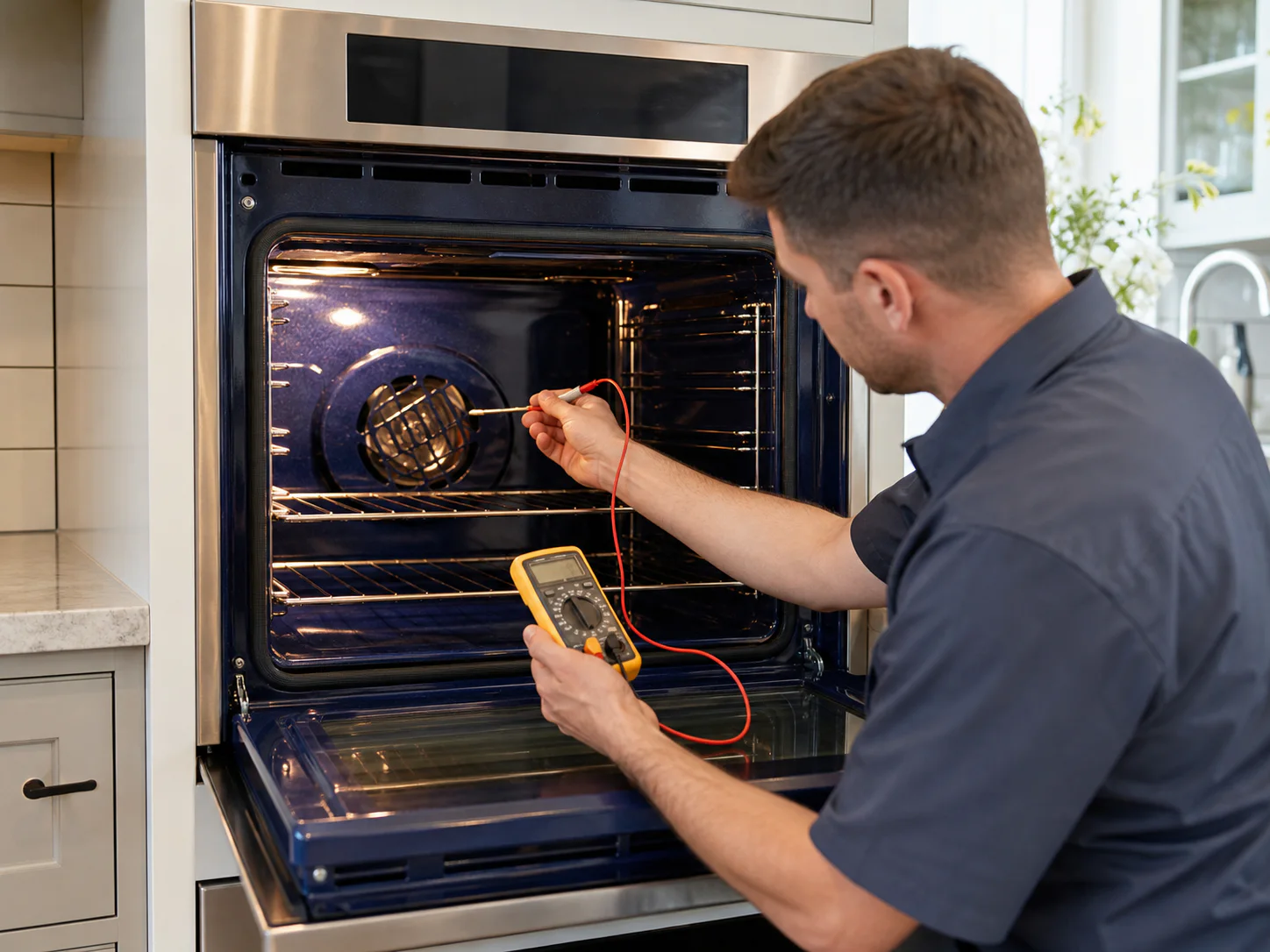
Wolf L Series single ovens include framed and unframed 30-inch variants and the wider SO36U platform. They share legacy electric oven principles but differ in cavity size, trim, control generation, access, and compatible components. Diagnosis identifies the exact model, cooking mode, heat stage, and whether the fault appears cold, during preheat, or after sustained operation.
Identify the exact equipment first
- Confirm SO30F, SO30U, or SO36U and full suffix
- Compare bake, broil, convection, and preheat behavior
- Record temperature-probe behavior, fan timing, codes, and door alignment
- Photograph the complete Wolf L Series SO30F, SO30U, and SO36U model and serial tag
- Record actual temperatures, error messages, noises, and the operating stage when the symptom appears
Protect people, property, and stored product first. Stop for gas odor, smoke, damaged wiring, active leaks near electrical parts, or repeated breaker trips. Leave internal gas, refrigerant, and live-voltage testing to a qualified technician.
Systems that shape the diagnosis
Bake and broil power paths
Elements, relays, wiring, high-limit protection, and incoming power can remove one heat mode while controls remain active.
Convection circulation
Fan motor, blade clearance, relay command, and airflow change temperature uniformity and can create mode-specific noise.
Temperature feedback
Sensor response, control interpretation, element output, door sealing, and rack position are evaluated before calibration.
Door, hinge, and lock
Door closure affects heat loss; hinge, gasket, latch, and self-clean lock conditions should be separated from electronic faults.
Legacy control and cooling
Display operation does not prove relay output, and cooling airflow can interrupt operation as the appliance heats.
Platform and production context
L Series is a legacy Wolf built-in oven platform with single-oven models in 30- and 36-inch formats. Framed, unframed, handle, and finish suffixes matter for access and parts.
A high-current electric cavity combines bake and broil circuits, convection, sensing, controls, door hardware, cooling ventilation, and self-clean protection.
Separate the symptom before selecting parts
No heat, one missing mode, slow preheat, inaccurate temperature, fan noise, shutdown after warming, door trouble, and error codes produce different test sequences. Record the exact mode and time into the cycle.
Access, identification, and service planning
Wall-oven removal requires power isolation, cabinet protection, adequate support, trim clearance, and a plan for the heavy door and chassis. Front-access testing should come first.
Use the complete SO model, framed or unframed designation, width, finish suffix, and serial number. Similar control panels do not establish component compatibility.
Frequently asked questions
Why can broil work while bake does not?
Bake and broil use separate elements, wiring, and relay outputs, so one circuit can fail independently.
Should an inaccurate L Series oven be calibrated first?
Only after normal sensor response, heating output, airflow, door sealing, and cycling are confirmed.
Is SO36U just a wider SO30U?
The service principles are related, but cavity, elements, trim, access, and compatible parts differ by width and generation.
Why is the full Wolf L Series SO30F, SO30U, and SO36U serial information required?
Production revisions can change controls, wiring, hinges, water components, and compatible replacement parts while the visible model family remains similar. The full tag keeps service planning tied to the correct technical documentation.
Ghost Appliance Repair is an independent service company and is not affiliated with or endorsed by Wolf or its manufacturer. Brand and model names identify the equipment discussed. Service and parts availability depend on the complete model, serial generation, condition, and location.