
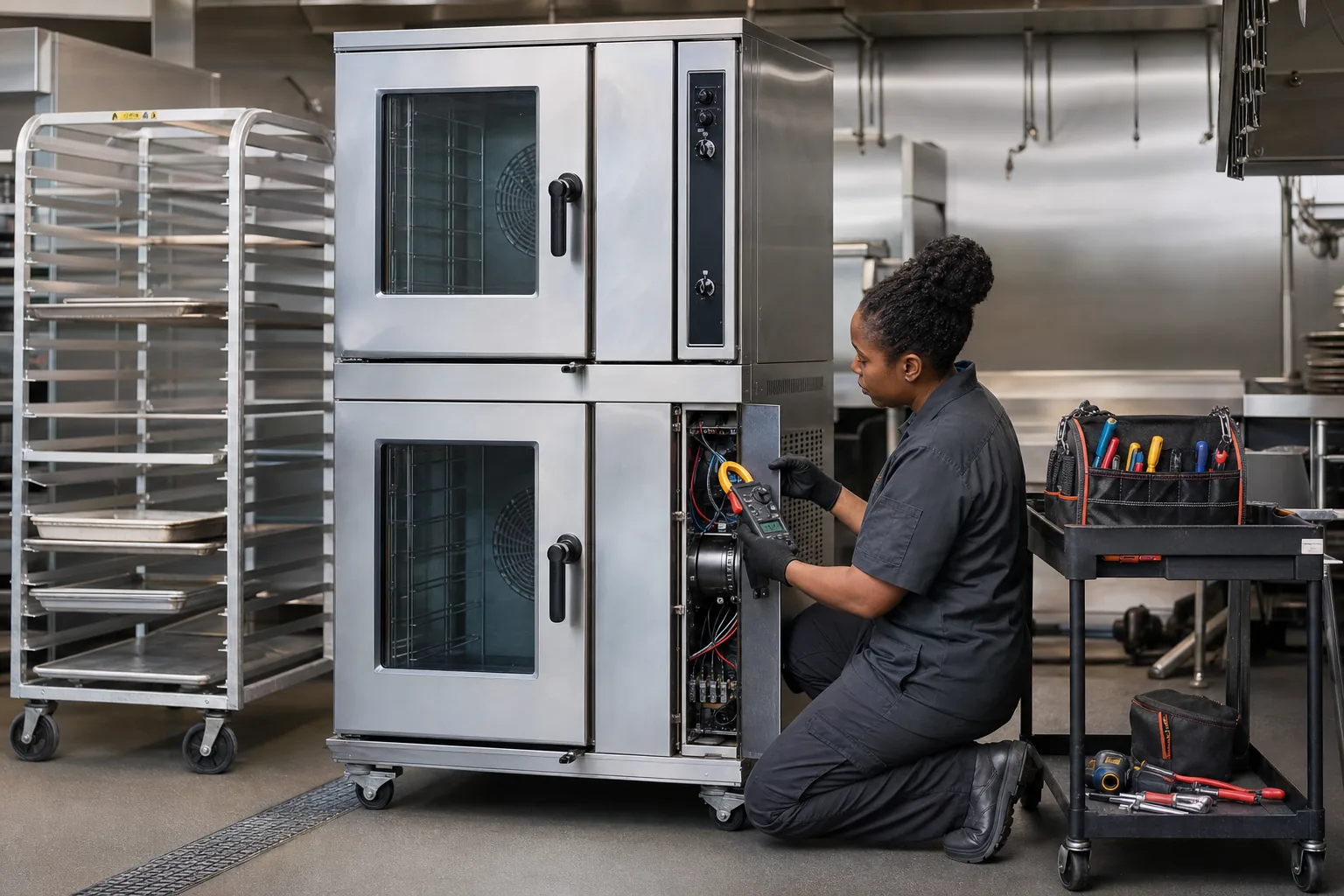
Commercial convection ovens are judged by heat recovery, airflow, and repeatability under production load. A cabinet can reach setpoint while baking unevenly if the fan, door, sensor, control, or burner and element sequence is wrong. Double-stack installations should be tested by cavity because one oven can fail while the other remains available.
Identify the exact equipment first
- Identify the affected cavity and cooking mode
- Record cold-start preheat and recovery after opening
- Map temperature at several rack positions
- Note convection fan speed, direction, and noise
- Inspect door closure, gasket, and latch pressure
- Photograph the complete manufacturer model and serial plate, including every suffix
Protect people, property, and stored product first. Shut affected equipment down for gas odor, smoke, arcing, exposed wiring, active water near electrical parts, unsafe temperatures, or repeated protection trips. Move temperature-sensitive product according to the business's food-safety plan and keep time-and-temperature records.
Systems that shape the diagnosis
Heat source
Gas ignition and burners or electric elements, contactors, and supply determine heat input. A running fan does not prove heat is present.
Convection airflow
Fan motors, wheels, direction, speed, and baffles distribute heat. Airflow faults create repeatable rack-position differences.
Temperature control
Sensors, thermostats, controllers, relays, and calibration determine cycling. Calibration is appropriate only after normal heat and airflow are confirmed.
Doors and venting
Gaskets, hinges, latches, and vent conditions affect recovery and kitchen heat. A leaking door can mimic weak heat input.
What the diagnosis should prove
Measure heat rise, cycling, rack-to-rack temperature, airflow, and recovery in the affected cavity. Compare the other cavity on a stack when safe. Do not diagnose from the ready light alone; product performance depends on stable conditions after loading and door openings.
Downtime, product, and operating context
Provide a cool empty oven and describe the products, pans, rack positions, and production period where the fault appears. Keep one cavity out of use if it overheats, produces combustion odor, trips protection, or has unsafe door hardware.
Repair scope and replacement decisions
Ignition, elements, contactors, sensors, controls, fans, and door parts are common repair scopes. Severe cavity damage, cracked heat exchangers where applicable, obsolete controls, or repeated motor failure from ventilation conditions can change the replacement decision. Production capacity matters as much as purchase price.
Frequently asked questions
Why does a commercial oven bake unevenly at the same setpoint?
Fan airflow, baffles, sensor location, door leakage, heat input, rack loading, and recovery can differ even when the display reaches setpoint.
Can one oven in a double stack keep running?
Potentially, if the systems are independent and the remaining oven is safe. Confirm the fault does not involve shared utilities, ventilation, or electrical conditions.
Should a commercial oven be calibrated first?
Only after heat input, sensing, airflow, doors, and normal cycling are verified. Calibration cannot correct a failed fan or intermittent burner.
What information should I send for commercial convection oven service?
Send the complete model and serial tag, power or fuel type, exact symptom, any code, measured temperatures when relevant, business hours, and clear photos of the installation and service access. Do not include customer or employee personal information in equipment photos.