
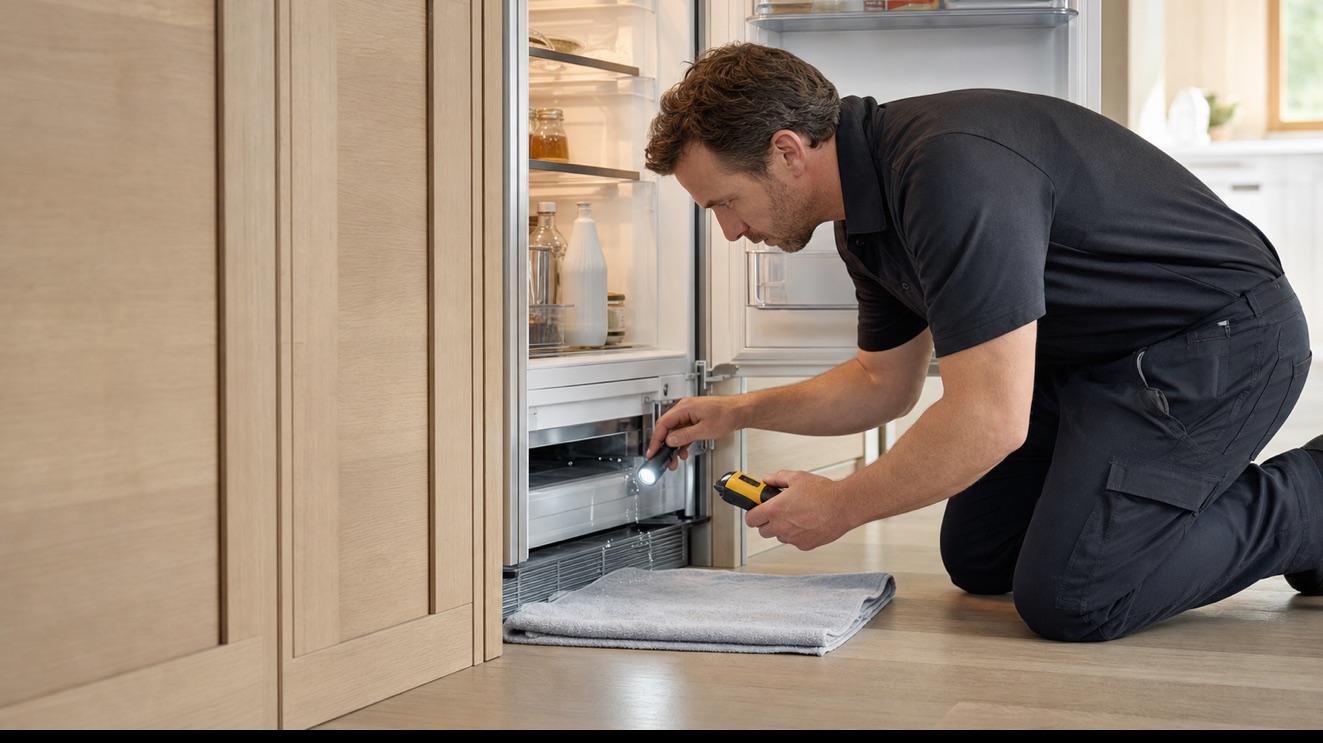
Water rarely travels straight down from the failed component. It can follow a liner, tube, cabinet seam, or finished floor before becoming visible. A useful Sub-Zero leak diagnosis therefore starts at the highest wet point and asks when the water appears: after ice production, during dispensing, after defrost, or continuously even while the appliance is idle.
Safe checks you can make first
- Protect the floor and stop use if water reaches electrical parts
- Photograph the first visible water before wiping it away
- Note whether the leak appears inside, below, or behind the cabinet
- Check for frost or ice above the wet area
- Observe whether ice production or dispensing changed at the same time
- Shut off the accessible appliance water supply for an active supply leak
Stop for gas odor, smoke, damaged wiring, active leaks near electrical parts, or repeated breaker trips. Avoid internal gas, refrigerant, or live-voltage work and arrange professional service.
Common causes behind the symptom
Defrost water is not reaching the drain system
A restricted drain, frozen drain path, damaged trough, or related heating condition can send defrost water beneath drawers or onto the cabinet floor instead of into the intended collection path.
The ice-maker fill path is leaking or freezing
A misdirected fill tube, seeping valve, partial freeze, or overfill can create drips, ice sheets, or a frozen mass near the ice maker. The last cubes often preserve useful evidence.
A filter, valve, fitting, or water tube is leaking
Pressurized water can escape only during a fill or dispenser request, or it can seep continuously. The highest wet connection needs to be identified before a visible lower component is blamed.
Door leakage is creating excess condensation
A gasket gap, drawer interference, hinge or panel alignment, or frequent incomplete closure can admit humid air. The resulting moisture may look like a plumbing leak even when the water system is dry.
Condensate collection or cabinet conditions have changed
A damaged pan, abnormal heat rejection, insulation condition, or installation issue can allow moisture to appear below a built-in cabinet. Nearby household plumbing should also be ruled out.
Leak timing is often more useful than puddle location
Water that appears after an ice harvest or dispenser request leads toward a different test than water that develops during a defrost period. Continuous seepage with the appliance idle increases concern about a pressurized supply path. Condensation near one door corner calls for a closure and humidity investigation before water valves are replaced.
Record the time, appliance activity, and first wet surface. A short safe video can preserve an intermittent leak, but do not keep running ice or water functions when doing so increases cabinet or floor damage.
Built-in panels can hide the path
Integrated refrigeration may route water behind trim, decorative panels, toe areas, or adjacent cabinetry. Service planning needs the full model and installation type so access protects panels, stone, flooring, and water connections. Pulling a heavy built-in unit without the correct procedure can create more damage than the original leak.
A technician may begin with the appliance installed, checking drain behavior, fill timing, supply pressure, valves, filters, door sealing, and temperature before removal is considered.
Know when to stop water and power
Shut off the accessible appliance supply when water flows continuously or spreads into cabinetry. Disconnect power only when it can be done without contacting water or damaged wiring. For water near a receptacle, junction, or electrical component, avoid the wet area and use the appropriate electrical disconnect or professional assistance.
Frequently asked questions
Why is water collecting under the drawers?
A restricted or frozen defrost drain is one possibility, but water can also descend from an ice-maker fill path, filter, tube, condensation, or a door-seal problem. The highest wet point identifies the next test.
Can a Sub-Zero ice maker cause a refrigerator leak?
Yes. Fill-tube alignment, valve seepage, overfill, a frozen path, or melting ice can create water or ice near the bin and below the cabinet.
Should I pull the refrigerator out to find the leak?
Not without the model-specific removal procedure and proper protection. Built-in equipment can be heavy and connected to panels, anti-tip hardware, water, and electrical service.
What should I photograph before service?
Capture the first visible water, any frost or ice above it, the drawer or door area, and the ice bin. Also record when the leak appears and whether dispensing or ice production changed.
Ghost Appliance Repair is an independent service company and is not affiliated with or endorsed by Sub-Zero or its manufacturer.