
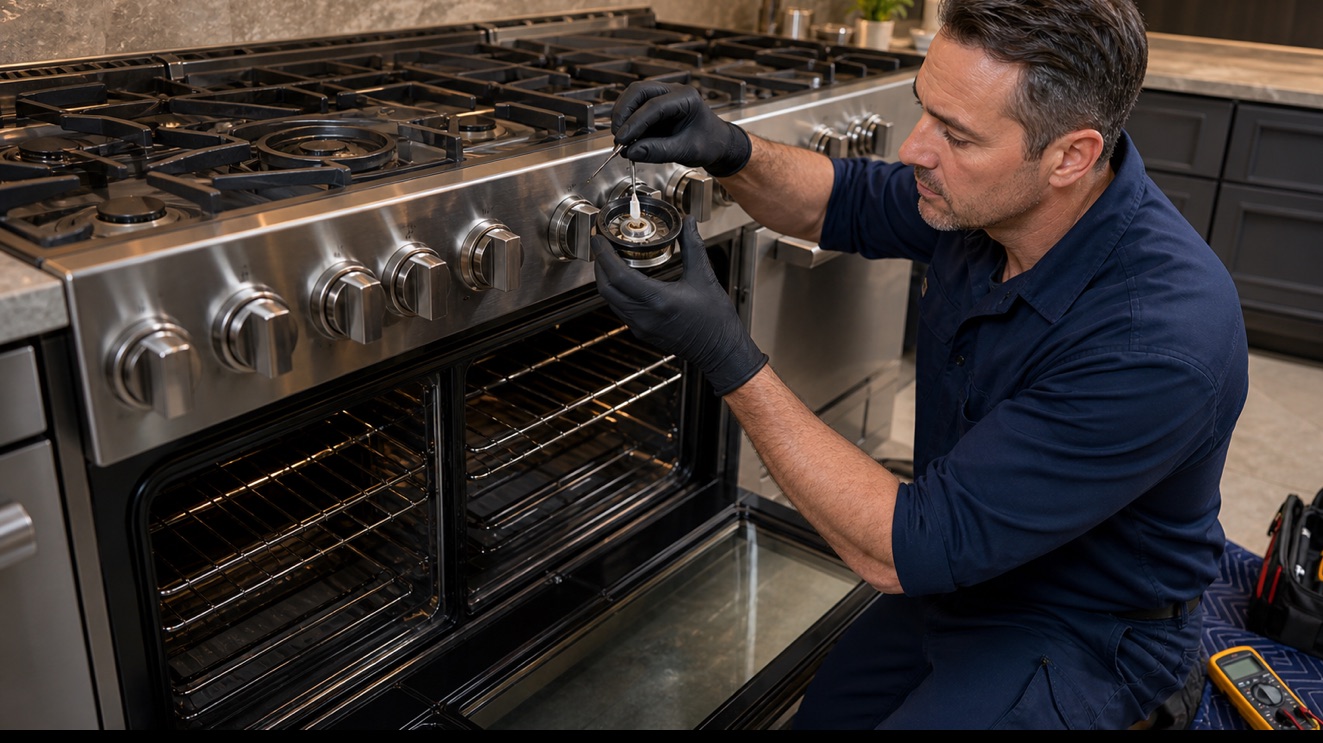
On a Viking range, 'not igniting' can describe a surface burner that clicks, an oven igniter that glows without flame, or an ignition system that does nothing. Identify the exact section first because each uses a different gas and electrical sequence.
Safe checks you can make first
- Turn off the appliance and ventilate if unburned gas is present
- Identify whether the surface burner, oven, or both are affected
- Let burner components dry after a spill or cleaning
- Confirm removable burner parts are seated according to the use guide
- Check whether other burners light normally
- Record delayed ignition, weak flame, clicking, and any error code
Stop for gas odor, smoke, damaged wiring, active leaks near electrical parts, or repeated breaker trips. Avoid internal gas, refrigerant, or live-voltage work and arrange professional service.
Common causes behind the symptom
Surface ports or spark path are disrupted
Food, moisture, misalignment, or electrode damage can keep the spark from igniting gas at the intended point.
Oven igniter cannot open the safety valve
A hot-surface igniter may visibly glow but remain electrically too weak for reliable gas flow.
Ignition switch or spark module has failed
No spark, continuous spark, or multiple affected burners can point toward shared electrical ignition components.
Gas delivery is abnormal
Valve, regulator, supply, or burner conditions can cause no flame, weak flame, or delayed ignition and require qualified gas-system testing.
Wiring, grounding, or control output is missing
Professional ranges contain separate ignition circuits. A working display or light does not prove power is reaching the affected circuit.
Surface ignition and oven ignition are separate diagnoses
A clicking surface burner directs attention to visible burner placement, moisture, spark quality, and shared spark controls. An oven that glows without flame requires current and safety-valve testing. Treating them as one generic igniter problem can lead to the wrong part.
Note whether ignition fails cold, after the appliance is hot, or only after cleaning. Intermittent heat-related failure often leaves different evidence from a permanently open circuit.
Gas odor changes the troubleshooting boundary
Do not continue cycling controls when gas is not lighting promptly. Turn controls off, avoid flames and electrical switches in the affected area, ventilate when safe, and follow utility or emergency guidance for a persistent odor. Appliance diagnosis begins only after the immediate hazard is addressed.
Frequently asked questions
Why does a Viking oven igniter glow but not light?
The igniter may be too weak to draw the current needed for the safety valve, or the gas and control circuit may have another fault. Visual glow is not a complete test.
Why do all surface burners click?
Some systems spark multiple burners by design. Continuous clicking after controls are off or flames are established can involve moisture, switches, wiring, grounding, or the spark module.
Can a clogged port be the only problem?
Yes, but port condition should be handled with the model-approved cleaning method. Ignition timing, cap position, electrode condition, and flame pattern also need consideration.
What model information is useful?
Provide the full model and serial number plus the affected burner or oven, fuel type, ignition sound, flame behavior, and any recent cleaning or spill.
Ghost Appliance Repair is an independent service company and is not affiliated with or endorsed by Viking or its manufacturer.