
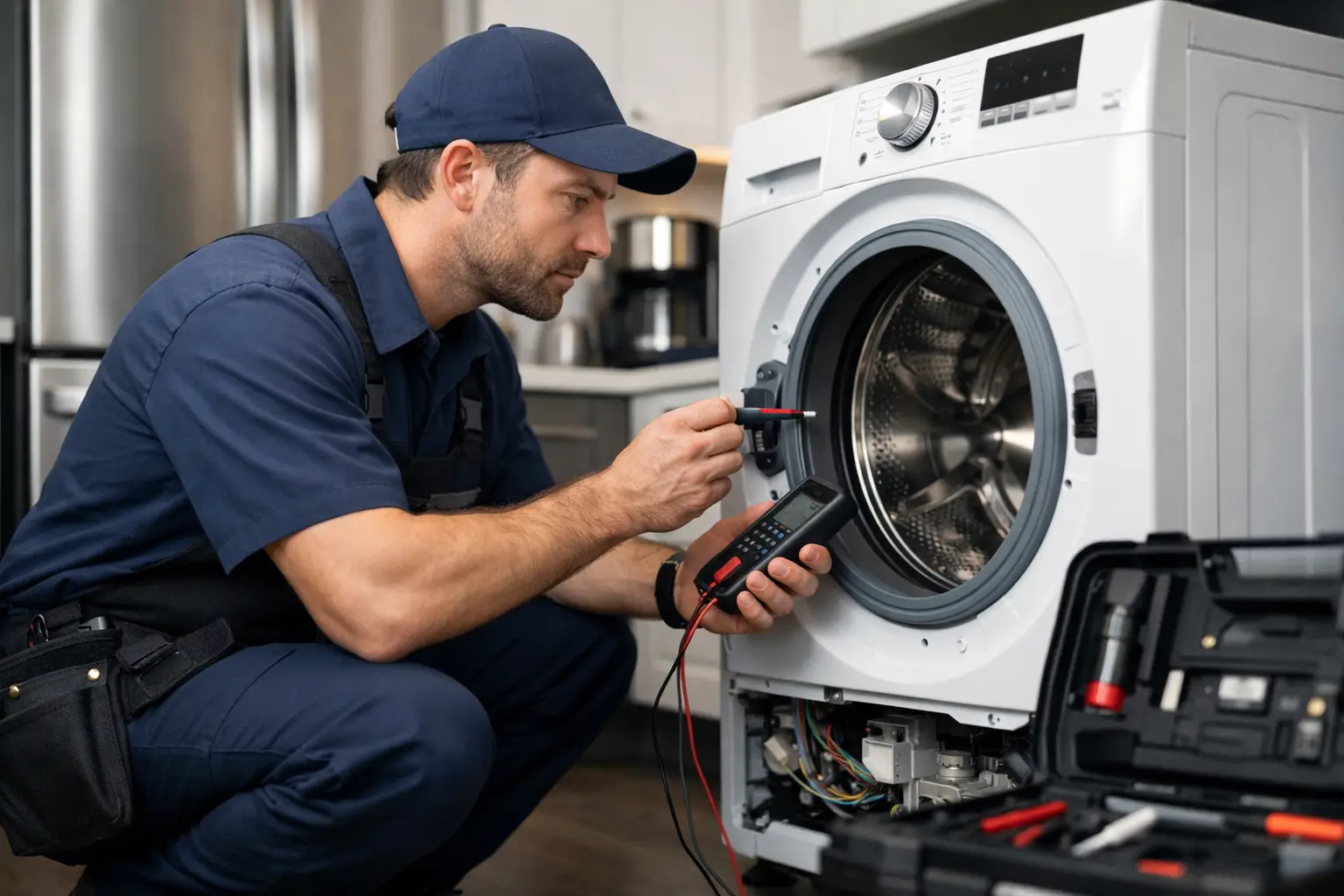
A washer that will not spin may actually be dealing with a drain, door-lock, balance, drive, or control problem. What happens immediately before high-speed spin is more useful than the final wet load alone.
Safe checks you can make first
- Check whether water remains in the tub
- Redistribute one heavy or visibly unbalanced load
- Confirm that the door or lid closes without forcing it
- Listen for the drain pump before spin should begin
- Record the full error code
- Do not force a locked door or reach beneath a plugged-in machine
Stop for gas odor, smoke, damaged wiring, active leaks near electrical parts, or repeated breaker trips. Avoid internal gas, refrigerant, or live-voltage work and arrange professional service.
Common causes behind the symptom
Drain restriction or pump failure
Many washers will not accelerate until the water-level system confirms an empty tub. A slow drain can therefore look like a spin failure.
Door or lid lock problem
The control prevents high-speed motion when it cannot verify that the opening is safely locked.
Unbalanced load or damaged suspension
The washer may repeatedly redistribute the load, stop early, or limit speed when excessive movement is detected.
Drive-system wear
A belt, clutch, coupling, rotor, stator, or related drive component can interrupt rotation depending on the washer design.
Motor feedback or control fault
Speed sensing, wiring, and the main control need testing when the tub moves freely and the drain and lock systems operate.
Separate a spin fault from a drain fault
Start by observing whether water leaves the tub. A machine that stops full of water needs a drain-path diagnosis before the drive is condemned. A washer that drains and tumbles but cannot reach high speed shifts attention toward balance, suspension, motor feedback, and control decisions.
One overloaded cycle can be corrected by reducing and redistributing the load. Repeated failure with ordinary loads indicates an appliance or installation condition that should be tested.
Leaks and movement change the urgency
Stop using a washer that walks, strikes the cabinet, leaks near electrical parts, or produces a burning smell. Continued high-speed attempts can damage hoses, wiring, the tub assembly, or the floor. Keep the error code and load details for the appointment.
Frequently asked questions
Why are clothes wet after the cycle ends?
The washer may have drained slowly, skipped final spin, limited speed because of imbalance, or stopped after a lock, drive, or control fault.
Can an unbalanced load stop spin?
Yes. Modern washers may pause or reduce speed to protect the cabinet. Repeated imbalance with normal loads can indicate leveling or suspension trouble.
Should I force open a locked washer?
No. Forcing the latch can add door and lock damage. Follow the model's user-accessible drain procedure or arrange service if water remains inside.
Does a humming pump mean it is working?
Not necessarily. A pump can receive power while its impeller is blocked, damaged, or unable to move water through a restricted drain path.