
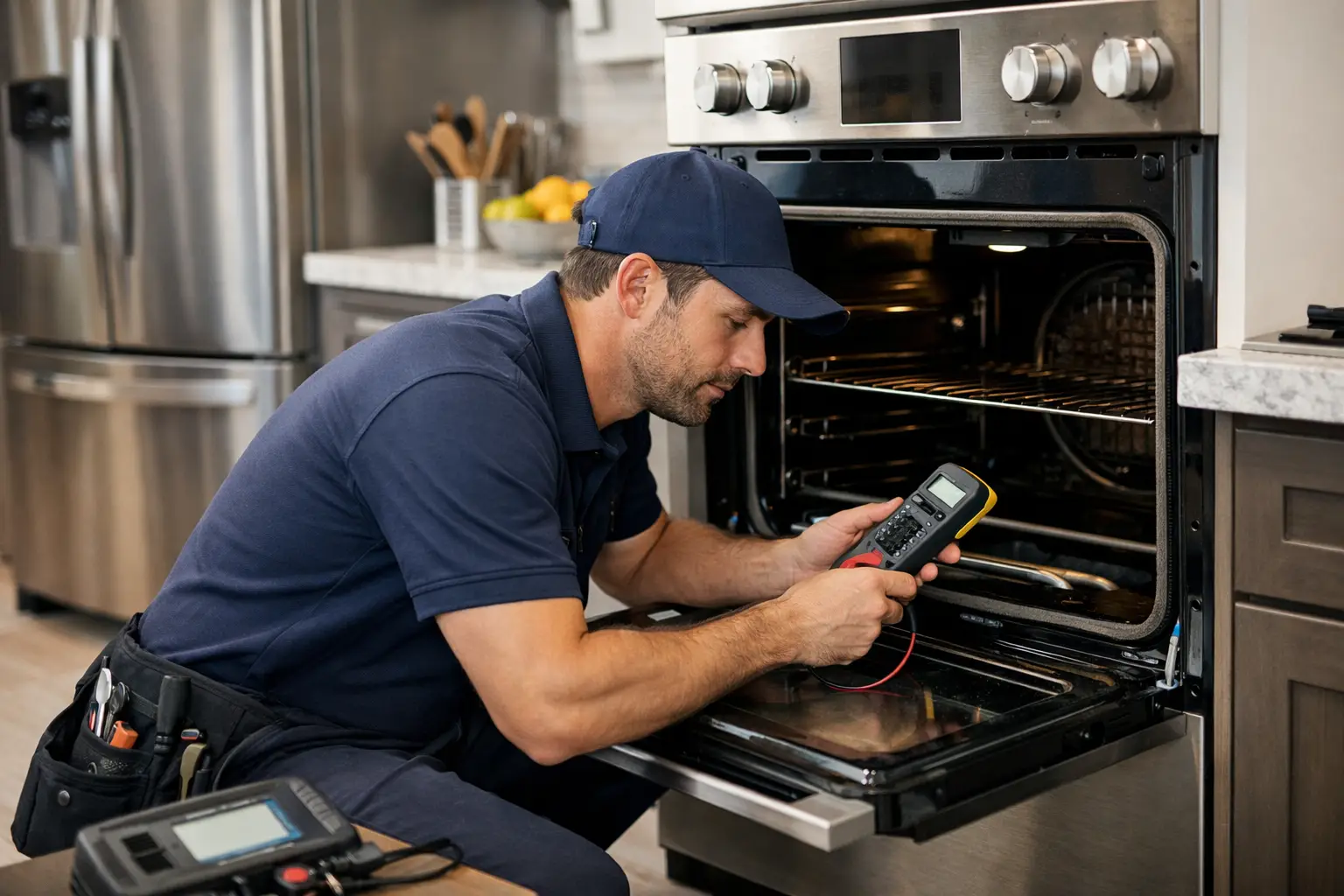
Missing heat and inaccurate heat are different faults. The most useful clues are whether preheat begins, whether bake and broil behave differently, and whether the oven loses temperature only after it has been running for a while.
Safe checks you can make first
- Confirm the selected cooking mode and temperature
- Compare bake and broil operation without opening panels
- Note whether preheat completes and how long it takes
- Look for a visible break or hot spot on an exposed element
- Record error codes and the cooking stage when they appear
- Stop if there is gas odor, smoke, arcing, or repeated breaker tripping
Stop for gas odor, smoke, damaged wiring, active leaks near electrical parts, or repeated breaker trips. Avoid internal gas, refrigerant, or live-voltage work and arrange professional service.
Common causes behind the symptom
Weak gas igniter
An igniter can glow and still draw too little current to open the safety valve reliably. Delayed ignition and very slow preheat are common clues.
Open electric heating circuit
A failed bake or broil element, connection, relay, or power leg can remove part or all of the oven's heat.
Sensor or calibration error
The display may show the target while the control receives an inaccurate cavity-temperature reading. Calibration is appropriate only after normal cycling is confirmed.
Convection and door losses
A weak fan, damaged gasket, or door alignment problem can create uneven results and slow temperature recovery.
Control or power fault
Relays, wiring, cooling fans, and supply voltage can interrupt heat even when the visible heating component appears normal.
Observe a complete preheat cycle
An oven may announce preheat before the cavity and cookware have stabilized. Diagnosis compares heat rise, cycling, and recovery after the door opens. A consistent small offset is different from wide swings or a temperature that falls throughout the cycle.
Gas and electric ovens require different measurements, and double ovens can fail in only one cavity. Share which mode and cavity are affected so the service visit starts with the correct circuit.
Do not use self-clean as a diagnostic test
Self-clean places sustained heat on the lock, controls, wiring, and cooling system. It should not be used to test an oven that already overheats, shuts down, reports a fan or lock error, or smells of damaged insulation. Record the symptom and arrange diagnosis instead.
Frequently asked questions
Why does a gas oven glow but not light?
A weakening igniter may glow without drawing enough current to open the safety valve. Gas-system testing should be left to a qualified technician.
Can an oven be calibrated instead of repaired?
Calibration can correct a small, consistent offset after the sensor, heating system, airflow, and cycling are shown to work normally.
Why does only broil work?
Bake and broil often use separate elements, igniters, wiring, or control relays. One mode working helps isolate the failed circuit but does not identify the exact part by itself.
Is it safe to keep using an oven with an error code?
Stop for overheating, gas odor, electrical odor, smoke, door-lock faults, or repeated breaker trips. Other codes still need model-specific interpretation before continued use.