
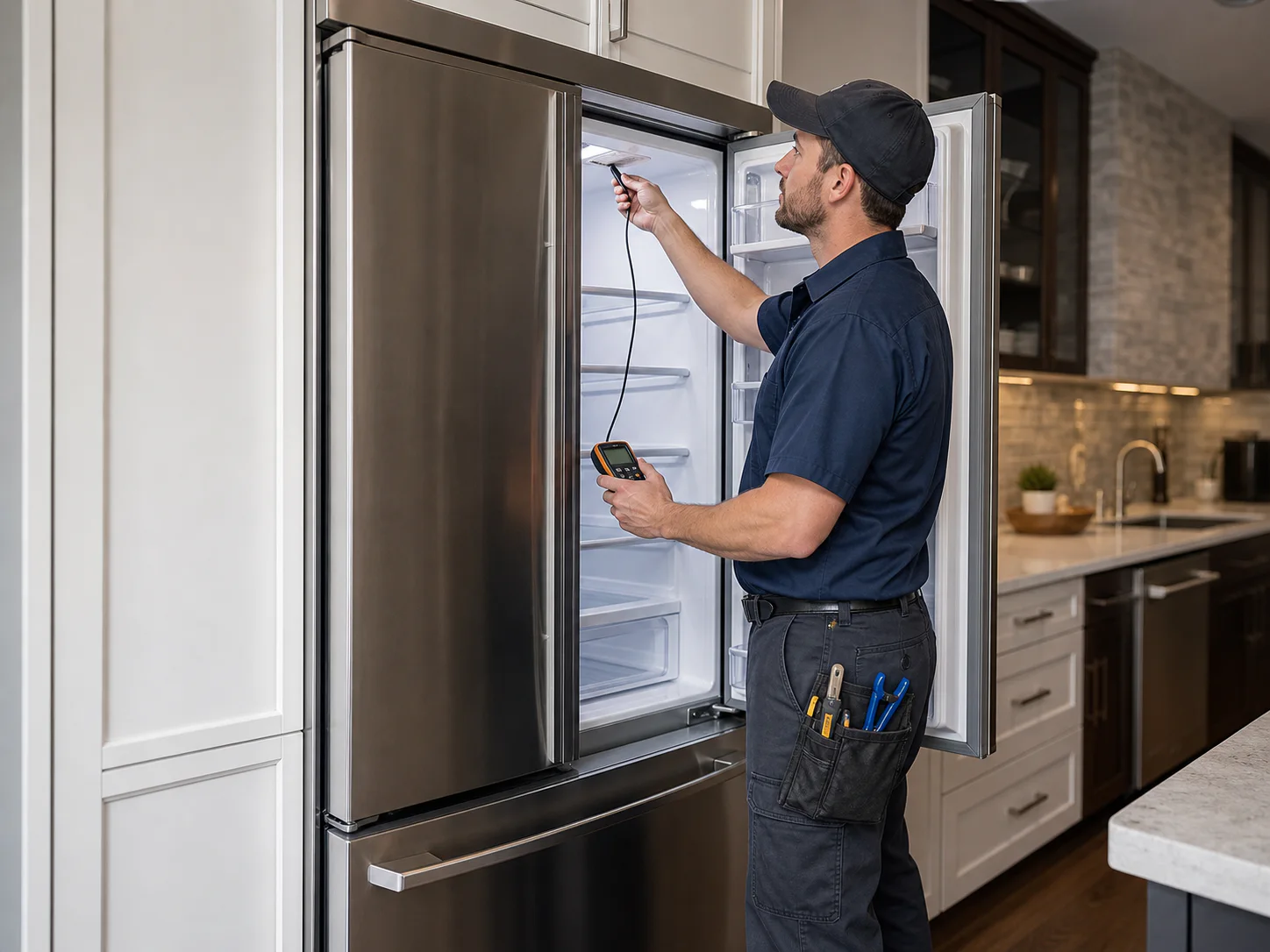
VCBB536 spans several numbered production updates, including 5361, 5363, and 5364-related documentation. The 36-inch bottom-freezer format remains recognizable, but controls, lighting, airflow, panels, and service parts can change by generation. Diagnosis must preserve the complete suffix instead of treating every 536 as identical.
Identify the exact equipment first
- Photograph the complete VCBB536 generation and suffix
- Measure upper refrigerator and lower freezer separately
- Record frost, ice, water, door, drawer, control, and fan evidence
- Photograph the complete Viking VCBB536 built-in refrigerators model and serial tag
- Record actual temperatures, error messages, noises, and the operating stage when the symptom appears
Protect people, property, and stored product first. Stop for gas odor, smoke, damaged wiring, active leaks near electrical parts, or repeated breaker trips. Leave internal gas, refrigerant, and live-voltage testing to a qualified technician.
Systems that shape the diagnosis
Generation-specific temperature management
Controls, sensors, fan strategies, and component revisions should follow the exact 536 generation.
Fresh-food circulation
Airflow, loading, fans, returns, sensing, and upper-door contact determine whether the refrigerator warms independently.
Freezer defrost and ice
Frost pattern, fan operation, drain, drawer seal, actual temperature, and water fill shape freezer and ice complaints.
Water and drainage
Ice fill, valves, supply connections, defrost drainage, condensation, and drain-pan routing can all create floor water.
Built-in ventilation and doors
Condenser airflow, grille clearance, panel geometry, hinges, rails, and gaskets influence load and run time.
Platform and production context
VCBB536 is a model family with multiple production-number generations rather than one fixed parts set. Current and retired Viking documentation should be matched to the exact tag.
A tall fresh-food compartment sits above lower freezer storage with ice, water, defrost, controls, and shared built-in heat rejection.
Separate the symptom before selecting parts
Separate upper, lower, and shared symptoms. Then identify whether the evidence is airflow, frost, sealing, water, controls, or refrigeration capacity before choosing the applicable generation diagram.
Access, identification, and service planning
Protect panels, floor, drawer rails, water line, ventilation, electrical connection, and anti-tip installation. A wide generation range makes pre-visit tag capture especially valuable.
Record every digit after VCBB536 and the serial number. A 5361, 5363, and 5364 may require different documentation and components.
Frequently asked questions
Why does the number after VCBB536 matter?
It identifies a production generation that can change controls, lighting, wiring, panels, and compatible parts.
Can a warm freezer stop ice production first?
Yes. Ice can slow before food visibly thaws, so actual freezer temperature must be measured.
Is floor water always a supply leak?
No. Defrost drainage, ice fill, condensation, valves, tubing, and pan routing can produce water near the appliance.
Why is the full Viking VCBB536 built-in refrigerators serial information required?
Production revisions can change controls, wiring, hinges, water components, and compatible replacement parts while the visible model family remains similar. The full tag keeps service planning tied to the correct technical documentation.
Ghost Appliance Repair is an independent service company and is not affiliated with or endorsed by Viking or its manufacturer. Brand and model names identify the equipment discussed. Service and parts availability depend on the complete model, serial generation, condition, and location.