
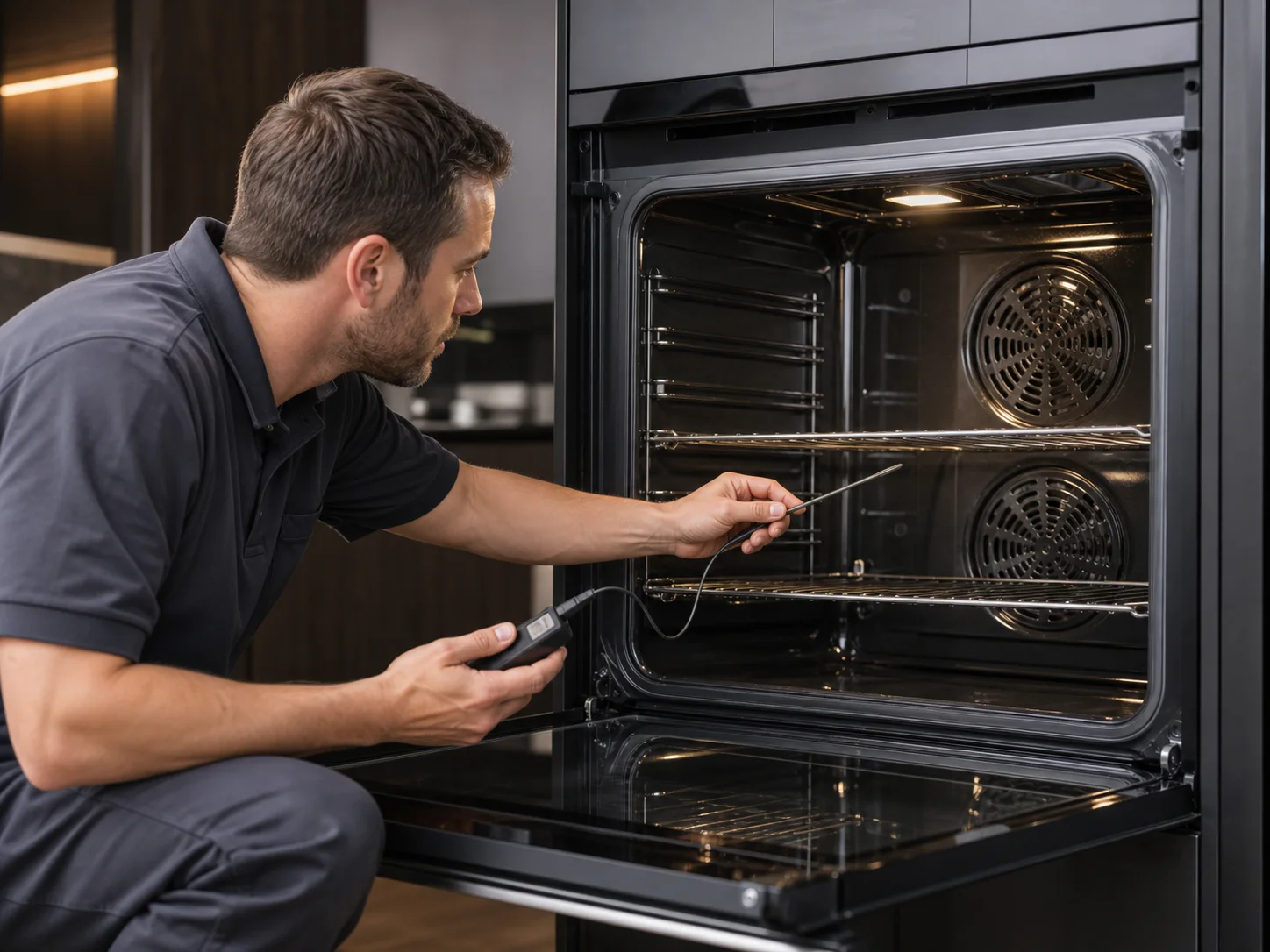
M Series ovens use a curved cavity and dual vertical convection arrangement, with professional, transitional, and contemporary styles and evolving 3050 generations. Those styling choices can affect controls, door operation, handles, and trim, while the core diagnosis still follows heat output, airflow, sensing, communications, and cooling.
Identify the exact equipment first
- Record single/double model, M Series style, and generation
- Identify the exact cavity, mode, and stage of failure
- Observe both convection fans, door movement, touchscreen behavior, and preheat timing
- Photograph the complete Wolf M Series SO30, DO30, SO3050, and DO3050 model and serial tag
- Record actual temperatures, error messages, noises, and the operating stage when the symptom appears
Protect people, property, and stored product first. Stop for gas odor, smoke, damaged wiring, active leaks near electrical parts, or repeated breaker trips. Leave internal gas, refrigerant, and live-voltage testing to a qualified technician.
Systems that shape the diagnosis
Dual vertical convection
Two fan paths and their control can affect mode-specific uniformity, fan noise, and recovery differently from other Wolf oven series.
Heating and relay output
Elements, relays, supply, wiring, and high-limit protection must be measured during the selected mode.
Touch control and communication
Interface response, control communication, stored codes, and cooling conditions should be separated from a heating-circuit failure.
Spring-and-damper door system
Hinge, damper, gasket, latch, and push-to-open equipment on applicable styles affect closure and heat retention.
Temperature feedback
Probe, cavity sensor, airflow, element output, rack position, and door loss determine whether calibration is appropriate.
Platform and production context
M Series includes single and double ovens across style and production updates, including newer 3050 designations. Professional, transitional, and contemporary variants are not always trim-only differences.
The platform combines electric heating, dual vertical convection, electronic mode control, temperature sensing, cooling airflow, and a distinctive door system.
Separate the symptom before selecting parts
Record whether the fault is one mode, one fan, one cavity, the interface, door movement, or performance after warm-up. That evidence separates local hardware from control communication and supply faults.
Access, identification, and service planning
Contemporary push-to-open and style-specific trim require identification before access. Any chassis movement requires power isolation, cabinetry protection, and adequate support.
Use the full model and serial, including style letters and 3050 generation. M Series alone does not identify the control, door, or trim package.
Frequently asked questions
Why does one M Series convection fan sound different?
A fan motor, blade clearance, bearing, airflow obstruction, or control command can affect one vertical fan path.
Can a door issue cause slow preheat?
Yes. Incomplete closure or gasket loss increases heat escape, though element, sensor, power, and airflow should also be evaluated.
Are M Series and E Series parts interchangeable?
Do not assume so. Their cavities, convection, controls, doors, and production generations differ.
Why is the full Wolf M Series SO30, DO30, SO3050, and DO3050 serial information required?
Production revisions can change controls, wiring, hinges, water components, and compatible replacement parts while the visible model family remains similar. The full tag keeps service planning tied to the correct technical documentation.
Ghost Appliance Repair is an independent service company and is not affiliated with or endorsed by Wolf or its manufacturer. Brand and model names identify the equipment discussed. Service and parts availability depend on the complete model, serial generation, condition, and location.