
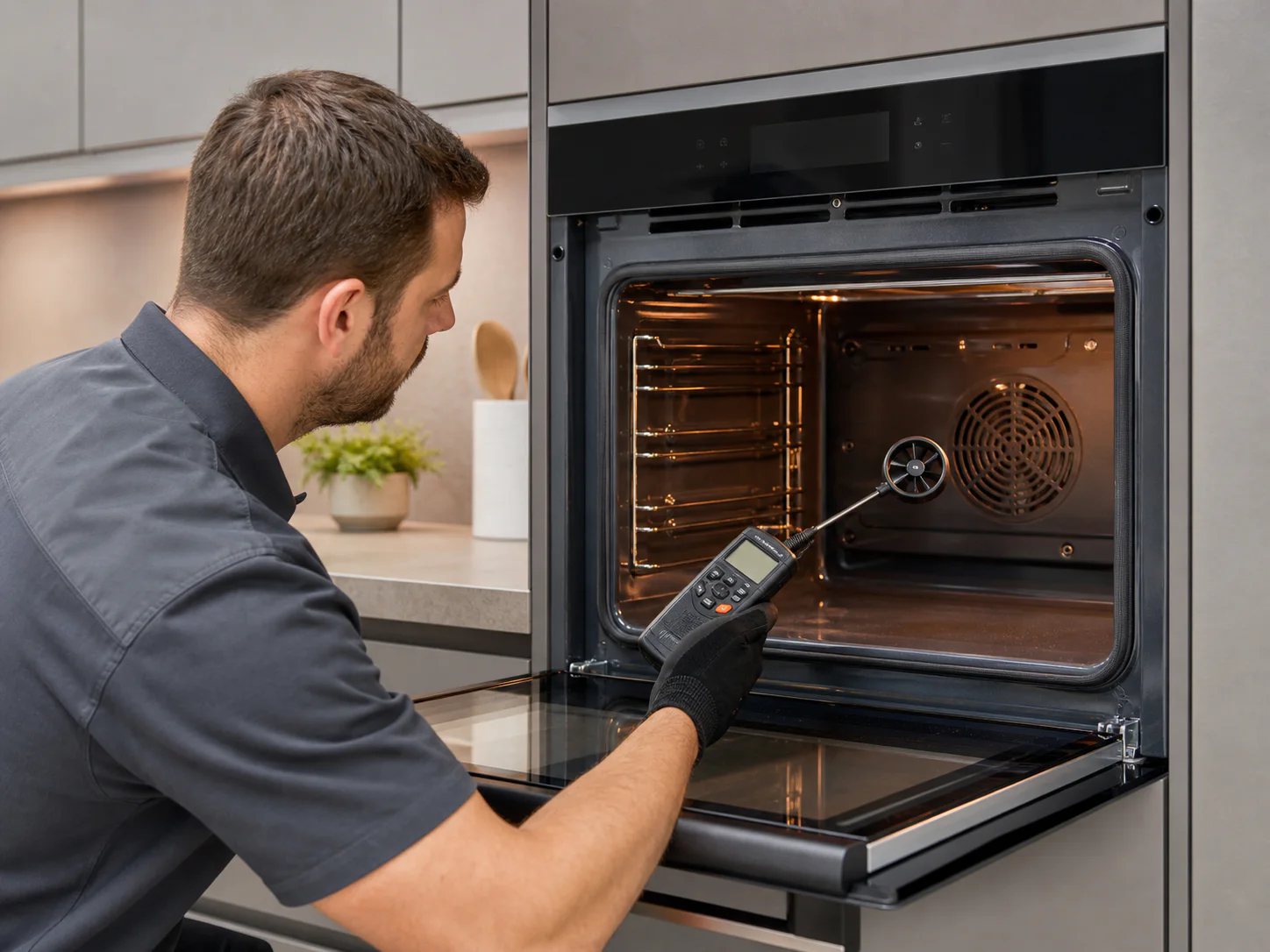
E Series spans legacy and current generations, so the words 'E Series' do not identify one control or convection architecture. SO and DO distinguish single and double ovens, while newer 3050 model numbers introduce different interfaces and production parts. Diagnosis begins with the complete tag and the exact cavity, mode, and sequence.
Identify the exact equipment first
- Record complete SO/DO model, style suffix, and 3050 generation if present
- Compare bake, broil, convection, and Gourmet behavior where equipped
- Capture touchscreen messages, fan timing, preheat time, and actual cavity temperature
- Photograph the complete Wolf E Series SO30, DO30, SO3050, and DO3050 model and serial tag
- Record actual temperatures, error messages, noises, and the operating stage when the symptom appears
Protect people, property, and stored product first. Stop for gas odor, smoke, damaged wiring, active leaks near electrical parts, or repeated breaker trips. Leave internal gas, refrigerant, and live-voltage testing to a qualified technician.
Systems that shape the diagnosis
Generation-specific controls
Legacy displays and current touch interfaces use different boards, communications, menus, and error interpretation.
Electric heating circuits
Element output, relays, wiring, supply, and high-limit protection are tested by mode rather than inferred from a lit display.
Dual-convection behavior
Fan operation, airflow, and cavity position affect preheat and uniformity; double ovens may not use identical convection hardware in both cavities.
Sensing and temperature performance
Actual cycling, sensor response, heat output, rack position, and door sealing come before calibration.
Door and cooling protection
Hinges, gasket, latch, cooling fans, and cabinet ventilation can produce heat loss, noise, or shutdown symptoms.
Platform and production context
Wolf E Series includes more than one production generation, from legacy SO30/DO30 platforms to current 3050 models. Cosmetic style names do not make those controls interchangeable.
Single and double electric ovens combine mode-specific heating, dual convection, temperature feedback, electronic controls, door systems, cooling airflow, and self-clean protection.
Separate the symptom before selecting parts
Identify legacy versus current generation, single versus double, affected cavity, mode, and timing. A touchscreen fault, no heat, uneven results, slow preheat, fan noise, and door issue should not share one parts assumption.
Access, identification, and service planning
Confirm generation before opening trim or ordering controls. Protect cabinetry and use safe support if chassis access requires removal.
Photograph every letter, number, slash, and serial digit. E Series alone is a marketing family, not a complete service identifier.
Frequently asked questions
Are all Wolf E Series controls interchangeable?
No. Legacy and current generations use different interfaces, boards, wiring, and documentation.
Why can a double E Series heat differently by cavity?
Cavities can have separate elements, sensors, fans, doors, and control outputs; some convection features also differ by cavity.
Does a completed preheat tone prove accurate temperature?
No. Actual cycling should be measured after stabilization and compared with sensor, element, airflow, and door performance.
Why is the full Wolf E Series SO30, DO30, SO3050, and DO3050 serial information required?
Production revisions can change controls, wiring, hinges, water components, and compatible replacement parts while the visible model family remains similar. The full tag keeps service planning tied to the correct technical documentation.
Ghost Appliance Repair is an independent service company and is not affiliated with or endorsed by Wolf or its manufacturer. Brand and model names identify the equipment discussed. Service and parts availability depend on the complete model, serial generation, condition, and location.